My explanation for the economic chaos
In 1983, screenwriter William Goldman (Butch Cassidy, Marathon Man, All the President’s Men, Princess Bride, et al.) wroteAdventures in the Screen Trade, a brilliant and entertaining analysis of the movie industry. His unforgettable takeaway line that summarized the entire 436-page book, the phrase that captured the essence of Hollywood, and now the single best explanation of why we’re in such a economic mess: “Nobody knows anything.”
Who are the nobodies? Well, there are the CEOs, the Treasury, the Fed, the Congress, the Administration, the SEC, the other regulators, the journalists, the investors and the voters. Did I leave anyone out?
You probably never thought that Hollywood’s moguls and the Masters of the Universe had so much in common, but they do. What else could account for this fiasco? Goldman’s phrase is the perfect answer to the question that everyone is asking – why? Simple. Nobody knows anything. Yet while so many know nothing, never have so many been paid so much to do so much harm.
As we enter this New Era of financial reform, we’re faced with one really dangerous law that our nobody-knows-anything economic leaders will incorporate into the new legislation/regulation/fiat that is being foist upon us. This law requires no majority in congress and no Presidential approval. But it will be enacted. The law, of course, is the Law of Unintended Consequences. That law will be the only sure thing to emerge from the tortuous process now going on in Washington.
New words to add to your crisis vocabulary
“Credit-default swaps.” A buck if you can explain what a credit-default swap is. I can’t. But I learned from this morning’s Wall Street journal that it’s “a complex type of investment that acts like an insurance policy on loans and bonds.” Of course. Now I understand. By the way, this (now-simpler-to-understand) instrument has grown this decade from almost nothing to over $60trillion. Trillion! By comparison, the GNP of the U.S. is a puny $14 trillion. Which gives rise to the next new word in our crisis vocabulary…
“Trillion.” The late Senator Everett Dirksen is perhaps best remembered for his comment in the 1960s on the mushrooming government budget: “A billion here, a billion there, pretty soon it adds up to real money.” (What would he think of $700 billion here, $700 billion there?) So for those who can’t comprehend what it a trillion is, it’s simple: a thousand thousand thousand thousand. That doesn’t help? Well, think of it this way. Those of us who are aging like to pretend that 50 is the new 30, and 70 is the new 50. So try this: trillion is the new billion.
“Toxic.” In the press, we no longer see the word “mortgage” all by itself. It’s “toxic mortgage.” To remind us all of what we’re dealing with, toxic means poisonous, virulent, noxious, deadly, dangerous, harmful, injurious, pernicious.
“Privatizing social security.” This is a phrase that you can delete from your vocabulary. It no longer has any meaning.
Speaking of nobody knowing anything
We’re all overwhelmed by the volume of political verbiage today; we’re in danger of its burying us. Recently, the commentary on Sarah Palin has been at the forefront of pundits’ opinions. To save you time, here is one of the better Palin comments I’ve read. It’s by Sam Harris, and appeared at the end of a long piece of his in the Sept. 29 issue of Newsweek:
What is so unnerving about the candidacy of Sarah Palin is the degree to which she represents—and her supporters celebrate—the joyful marriage of confidence and ignorance. Watching her deny to Gibson that she had ever harbored the slightest doubt about her readiness to take command of the world's only superpower, one got the feeling that Palin would gladly assume any responsibility on earth:
"Governor Palin, are you ready at this moment to perform surgery on this child's brain?"
"Of course, Charlie. I have several boys of my own, and I'm an avid hunter."
"But governor, this is neurosurgery, and you have no training as a surgeon of any kind."
"That's just the point, Charlie. The American people want change in how we make medical decisions in this country. And when faced with a challenge, you cannot blink."
The prospects of a Palin administration are far more frightening, in fact, than those of a Palin Institute for Pediatric Neurosurgery. Ask yourself: how has "elitism" become a bad word in American politics? There is simply no other walk of life in which extraordinary talent and rigorous training are denigrated. We want elite pilots to fly our planes, elite troops to undertake our most critical missions, elite athletes to represent us in competition and elite scientists to devote the most productive years of their lives to curing our diseases. And yet, when it comes time to vest people with even greater responsibilities, we consider it a virtue to shun any and all standards of excellence. When it comes to choosing the people whose thoughts and actions will decide the fates of millions, then we suddenly want someone just like us, someone fit to have a beer with, someone down-to-earth—in fact, almost anyone, provided that he or she doesn't seem too intelligent or well educated.
I believe that with the nomination of Sarah Palin for the vice presidency, the silliness of our politics has finally put our nation at risk. The world is growing more complex—and dangerous—with each passing hour, and our position within it growing more precarious. Should she become president, Palin seems capable of enacting policies so detached from the common interests of humanity, and from empirical reality, as to unite the entire world against us. When asked why she is qualified to shoulder more responsibility than any person has held in human history, Palin cites her refusal to hesitate. "You can't blink," she told Gibson repeatedly, as though this were a primordial truth of wise governance. Let us hope that a President Palin would blink, again and again, while more thoughtful people decide the fate of civilization.
Memories of another era in the computer industry
In January 1980 (well before investment banks became bank holding companies) I retired as a securities analyst from Morgan Stanley to move on to other endeavors. To celebrate my change in career, and in lieu of anyone else volunteering, I threw myself a party at the then hub of Silicon Valley, Rickey’s Hyatt House, in Palo Alto. I had a lot of photos of the party, but unfortunately, most of them have gone to that Great Gallery in the Sky. I did, however, recently came across these few. (We were younger then, and more hirsute.)
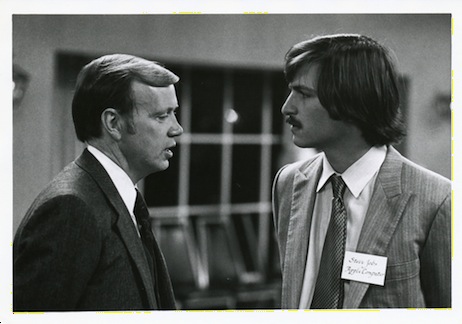
Regis McKenna (PR guru) and Steve Jobs (Apple)
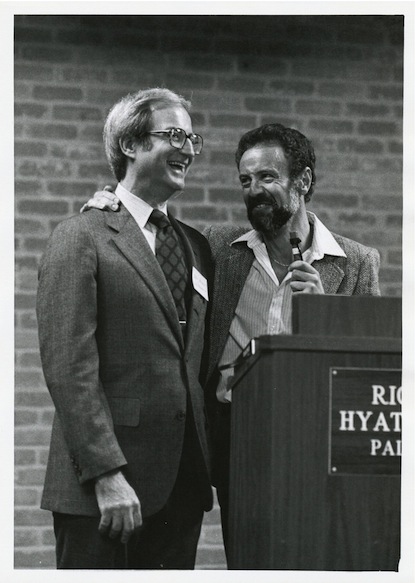
Ben Rosen and Andy Grove (Intel)
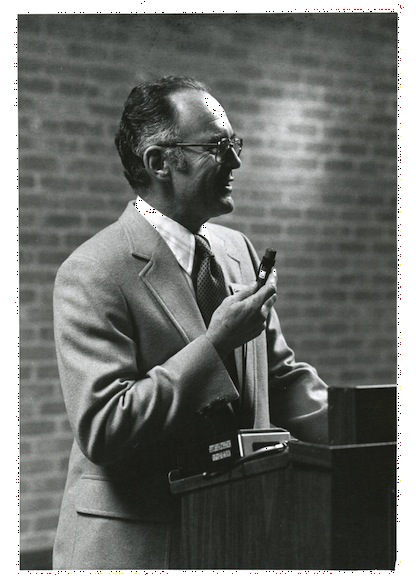
Gordon Moore (Intel)
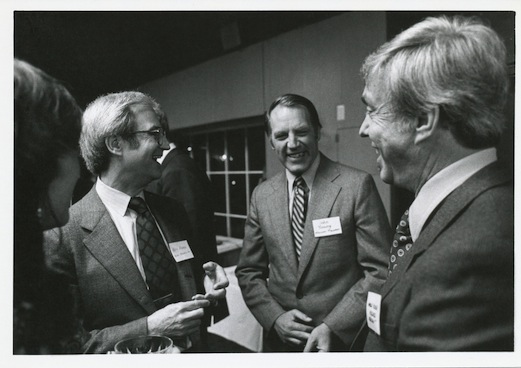
John Young (HP) surrounded by Rosens
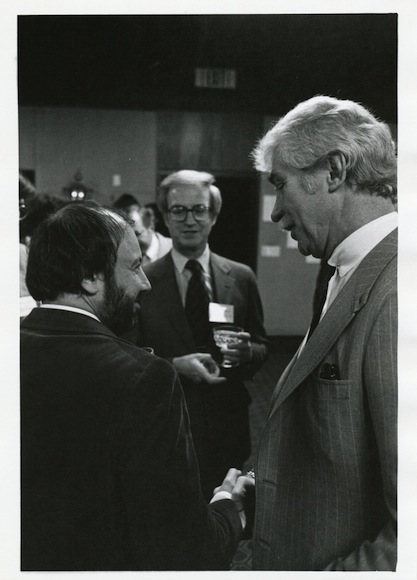
Jerry Sanders (AMD - right)
Electric vehicle update
“Your vehicle is ready to be shipped to you soon.” That’s the email I received today from Tesla Motors regarding the Roadster that that I've had on order for several years, and I can’t wait. In fact, I got so antsy waiting for it – it’s a year and a half late -- that I recently bought a Segway – the two-wheeled Human Transporter that was the most hyped product of its time. Introduced in 2002, the self-balancing Segway is an engineering tour de force, a truly remarkable feat of applying sophisticated technology to solving a problem. The problem, however, turned out to be one that few had. It reminded me of Amazon.com’s electronic reader, the Kindle – another example of technology searching for a problem.
My experience so far with the Segway has paralleled the disappointing response of the broader market. In the few weeks that I’ve owned it, I’ve been hard-pressed to find a useful application. It is, however, an amusement for outdoor parties in the summer, though I do get concerned about the adequacy of my insurance coverage when first-time users try it out, especially after they’ve had a libation or two.

Guest aboard the Segway
Oh, yes, Tesla has now engendered competition from two of the (formerly) Big Three, General Motors and Chrysler. They have both announced electric cars, but not all-electric (as is Tesla’s design). The newer offerings have a fully-charged battery range of 40 miles that can be extended to hundreds of miles by an onboard gasoline engine. Both all-electric and range-extender approaches have merit; actual experience in service will determine the better solution. One other difference: Tesla hasn’t asked the Washington for $25 billion, as have the Big Three, to support its effort. How last century not to ask for a government bailout!
Google Lunar X follow-up
My high hopes (Spin Me to the Moon) that my brother Harold and his Southern California Selene Group would win the $20 million first prize have been dashed. The team withdrew from the competition, even though they had such an incredibly clever design. The issue? It turns out that the prize’s sponsors had as a goal not an elegant and low-cost scientific mission to the moon, but rather an absurd goal of commercializing space – e.g., mining the moon, beaming power to the earth, and other such dubious ventures.
Harold decided there was no way he wanted to be involved in promoting a goal he doesn’t believe in, or, as he puts it, “an outrageously unrealistic version of space commercialization.”
Another poignant follow-up
Ten-year-old Eclipse Aviation, the pioneer of the very-light-jet industry, is going through significant growing pains. And then some. Ten years after founding the company, CEO Vern Raburn was forced out by the board. Not the first time a founder has been replaced, but no less sad when it happens, especially when it involves a friend of 35 years.
A note on philanthropy
Two related items caught my attention this week. Alberto Vilar, erstwhile technology investor and philanthropist, went on trial Monday on charges of defrauding his investors. Today the New York Sun ran a piece about a forthcoming biography ofMaimonides by Joel Kraemer. What’s the link between the two items?
Let’s start with Maimonides, the 12th century Jewish philosopher (and also doctor and rabbi), whose most famous work was hisGuide to the Perplexed. (Should be a good market today for a book with that title.) Among Maimonides’s interests was philanthropy. He wrote of the seven levels of virtue in charitable giving. They are, in ascending order of virtue:
7. The least virtuous, to give grudgingly.
6. Next, and more virtuous, to give less than one should, but graciously.
5. Next, to give what one should, but only after being asked.
4. Next, to give before being asked.
3. Next, to give without knowing who will receive the gift, though the recipient knows who you are.
2. Next, and almost the best, to give anonymously.
1. And finally, the most virtuous of all, to give anonymously, with the recipient not knowing who you are.
Now let’s switch to Mr. Vilar. His story as a most generous donor to opera and classical music organizations is well known. As is his running into financial difficulties after the tech bubble burst and becoming unable to fulfill many of the sizable pledges he had made during the salad days of tech investing. But what I found most interesting about his philanthropy was not just his passion for the arts, but also for personal recognition. Naming rights are now a well-established part of the charity game – he who gives the money gets the right to name the building/hall/room/seat/ashtray. But Alberto took it to a new level, at least in one case.
Some years ago, when he was negotiating funding for a new Met Opera production, he submitted an unusual request to then general manager Joe Volpe. Alberto wanted his name, as production funder, to be listed in the Playbill in type the same size as the composer’s, arguing that the importance of Alberto Vilar to the production was equal to that of Mozart.
Request denied.
Joe Volpe could handle Vilar, but I’m not sure what Maimonides would make of him. I do know, however, where Vilar would rank in the seven levels of virtuous giving.
Few donors today rank in Tier No. 1 of virtue – anonymous giver, and anonymous even to the recipient. Today’s eight- and nine-figure donors typically expect pretty prominent name recognition. But just today I learned that the principal donor to the new Frank Gehry hall being built for Miami Beach’s New World Symphony comes close. The $90 million lead gift for the $150 million campus has been donated anonymously. That would make Maimonides happy.
A day at Lime Rock
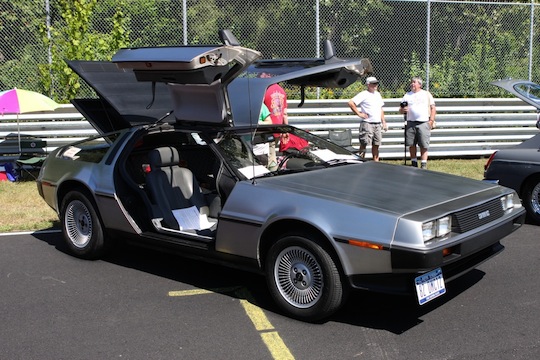
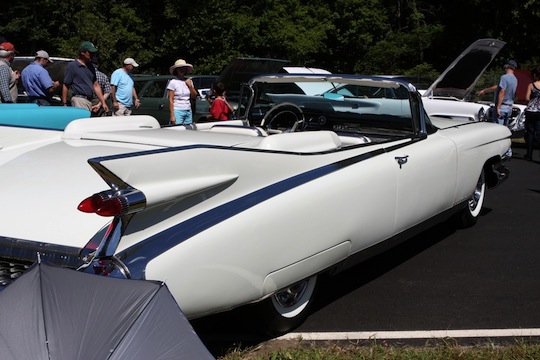
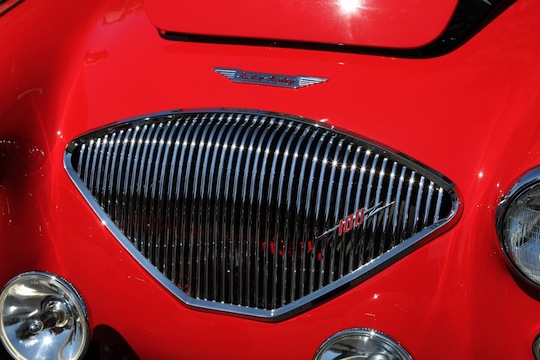
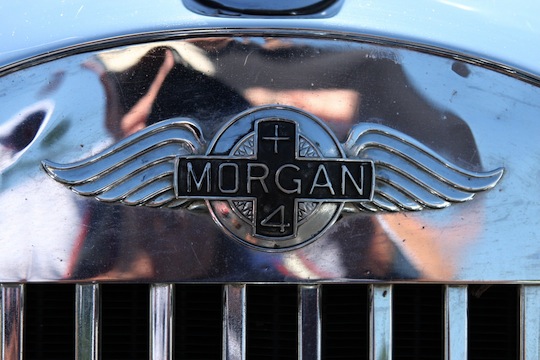
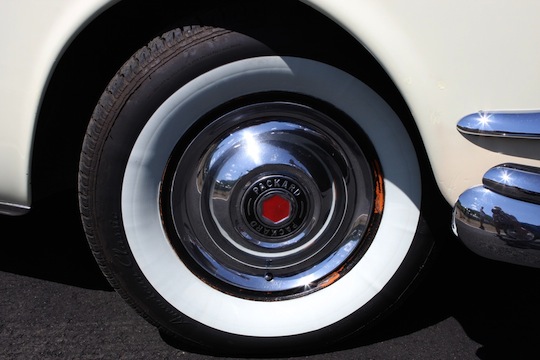
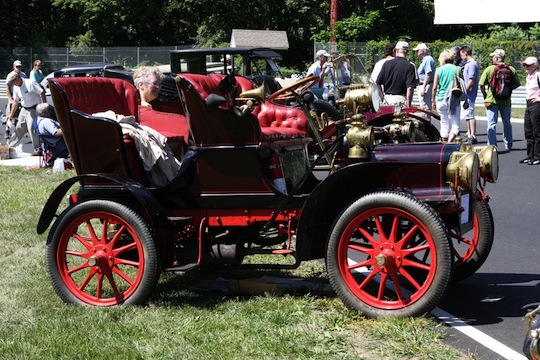
Every Labor Day weekend, Lime Rock race track in northwestern Connecticut hosts the Rolex Vintage Festival, a display of old and very old sports and racing cars, with a few other non-racing classics thrown in for good measure (e.g., , 1930 Pierce Arrows, postwar tailfin Cadillacs).
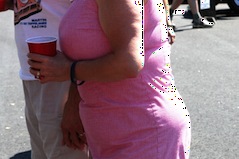
Two things struck me. First, most of the cars were sleek or sexy or elegant or outrageous or unique or inspiring or nostalgia-inspiring. Second, many of the people staring at the cars were none of the above.
First, the cars:






Second, (some of) the people :








How do we explain the creative process? How does an artist, a writer, a scientist, starting with nothing but an idea, create something from nothing? How does a novel emerge from a blank page, a painting from an empty canvas, an invention from a curious mind?
I’ve always been fascinated by the process that allows talented people to start with nothing more than a tabula rasa, then apply their creative abilities and end up with a contribution to society. Being fascinated is one thing, explaining it is another. So rather than attempt to explain, I thought that I would fascinate.
Over the years, Donna and I have been fortunate enough to make acquaintances with quite a few remarkably creative people, with their achievements originating from both sides of the brain – painters, sculptors, writers, composers, musicians, inventors, engineers, scientists, physicians, playwrights, producers, directors, actors, singers, et al.
I’ve begun to prevail on some of them to share their experiences with me on video – what they created, how they did it, why they did it. The hoped-for result is that the interviews will be entertaining and perhaps even illuminating. We may or may not infer how creativity is effected, but at a minimum we should enjoy watching talented people talk about themselves and their work.
The first video interview in this series is with the writer Edmund Morris. In 1980, Edmund won the Pulitzer Prize in Biography for The Rise of Theodore Roosevelt. In addition to his trilogy on T.R., Edmund has also written biographies of Ronald Reagan and Beethoven.
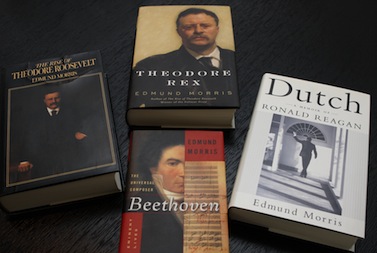
Kenyan-born, Edmund lives with his biographer wife Sylvia (Edith Roosevelt, Clare Boothe Luce) just a stone’s throw from chez nous in Litchfield County, Connecticut.
[Video to be re-inserted soon.]
Click on play button for Edmund Morris video
When we accompanied the New York Philharmonic on its historic trip to North Korea for its February 26 concert, the question that we were asked most often was, “Why?” Why was an American classical music organization invited to perform in the capital of a country with whom we’ve technically been at war since 1950? Was it simply to hear the Western classical music canon that is largely absent from North Korea? Was it a PR stunt orchestrated (so to speak) to burnish the international profile of the cruel, despotic ruler Kim Jong Il? Or did it have subtler implications?
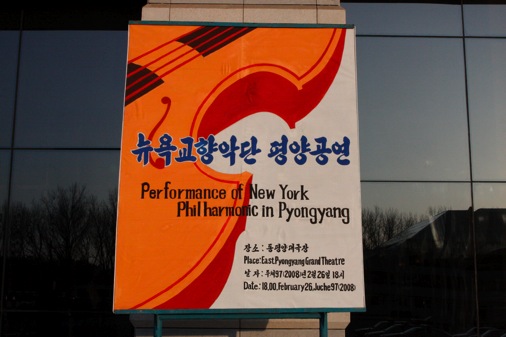
Remember, North Korea is one of the three countries, along with Iraq and Iran, that President Bush characterized in his 2002 State of the Union address as members of the “axis of evil.” And we know what he chose to do subsequently with one member – Iraq. And today, sabers can be heard rattling regarding Iran. But North Korea? That most repressive, most Stalinist of governments, and the only axis member with a demonstrated nuclear capability?
In my post of February 27, written and filed from Pyongyang, I asked questions of my own: “Will history remember this night? Can a musical event have any influence on bringing together two nations that have no diplomatic relations? Can a concert conceivably have any impact on the six-party talks that are attempting to get North Korea to give up its nuclear weapons?”
I also related a conversation I had there with Bill Perry, a former secretary of defense during the Clinton administration (and former acquaintance of mine during our Stanford engineering-school days during the 1950s). Perry suggested – against the conventional wisdom -- that the parties are beginning to realize that they are “likelier to reach an agreement in this final year of the Bush administration than to wait for a new president in 2009.”
I wrote further that "the talks were at a tipping point, one that will be brought about by the opposing parties’ reducing their distrust of each other. The concert tonight could help bring about that reduction. The goodwill demonstrated by the North Korean government – they really pulled out all the stops – and the support of our State Department could be meaningful harbingers."
I concluded my post with questions of my own: “North Korea giving up arms? The US and North Korea resuming diplomatic relations? Can it happen? Yes. Will it happen? To be continued.”
Well, believe it or not, the Bush administration has chosen, at least in the case of North Korea, diplomacy over war. Condy Rice has won, and the anti-diplomacy Dick Cheney-John Bolton faction has lost (The Tragic End of Bush’s North Korea Policy, WSJ, June 30).
After years of zero progress in the three-party talks,
here are three major developments since the February concert.
(1) Diplomacy Is Working on North Korea
By Condoleezza Rice
Wall Street Journal, June 26, 2008
Op-ed piece by Rice that laid the groundwork and rationale for diplomacy.
(2) Deal Reached in North Korea Talks
Associated Press, July 12, 2008
“North Korea agreed to disable its main reactor by the end of October and allow international inspections to verify its nuclear disarmament in a deal reached Saturday at the end of six-nation talks.
“In response to North Korea’s nuclear declaration the United States announced it would remove the country from its list of state sponsors of terrorism and relax some economic sanctions against it.”
“The United States and Russia pledged to provide the outstanding amount of heavy fuel [500,000 tons of fuel oil] by the end of October.”
(3) Rice Meets With North Korea Envoy
Associated Press, July 24, 2008
“US Secretary of State Condoleezza Rice met North Korea’s top diplomat Wednesday in Singapore, ending a four-year hiatus in Cabinet level contacts between the Bush administration and Pyongyang over its nuclear program.”
Finally, Progress
In just a few months' time, the State Department has made more progress than in the preceding seven and a half years of the Bush administration. We're not yet at the point of North Korea's becoming a golf resort destination (as is Vietnam), but we have moved off the dime. We’re engaged in diplomacy, we’re talking to people who are not our friends, and we’re making headway.
So, once again, why was the New York Philharmonic invited to perform in Pyongyang? My answer: It initiated a dialog between the people of two adversaries, the first dialog in 58 years. Maybe this musical event was not the only factor in jump-starting the resumption of discussions between the two countries, but I like to think that it was. Paraphrasing the mantra of the 60s, “Make music, not war.”
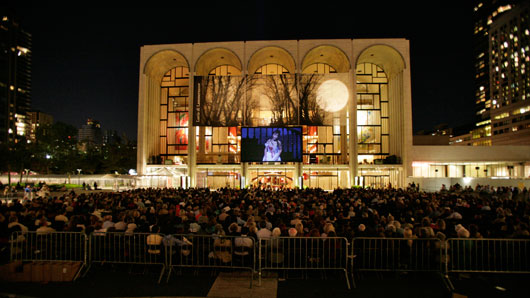
Opening night at the Met, 2007-08 season
Okay class, pay attention. Here’s today's business problem:
It’s 2006. You’re hired to run the largest performing arts organization in the world, a 125-year-old household name. Every year, you stage over 200 performances per year of a couple of dozen different operas. Your performances are heard by millions of radio listeners around the world. And until the year 2000, your ticket was the hardest to score in New York City.
But in the last six years, everything’s gone awry. Attendance has declined sharply. Costs have risen every year. Philanthropic contributions have flattened out. The endowment is woefully inadequate. Competition for the cultural dollar is soaring. There are signs of organizational complacency. And even though your audience is disappearing, you have no marketing organization in place to try to offset the decline.
What to do? Can anything be done? Is there a solution?
Well, in fact, this would indeed make a splendid business-school case study. And a much more interesting one than the run of corporate cases that MBA students are challenged with.
The dire situation outlined above is not hypothetical; it’s real. It’s what faced the Metropolitan Opera just two years ago. A little background:
In the 1990s, the Met essentially sold out the house every night. The 4,000-seat theater was filled seven times per week for over thirty weeks per year. Every night a different opera. Costs rose every year, but they were offset by the ability to raise ticket prices with impunity. Philanthropy was healthy, so the lack of a healthy endowment was not an issue. Also unimportant was the lack of a marketing team -– no need to create demand when almost every performance sells out.
Then came the millennium, and everything changed, and for the worse -– attendance, philanthropy, competition, subscriptions, and the bottom line. There are a lot of reasons for this collapse. For the Met it was a virtual perfect storm. Early in the decade, a recession began. Then 9/11 rocked the world. This tragedy, in turn, adversely affected travel, cutting down sharply visits by domestic and international opera-goers.
Customers began to resist the high price of attending an opera. And changes in lifestyle caused the subscription rate to fall -- less planning in advance, more spontaneous ticket-buying. As subscription-ticket sales fell, they had to be offset by single-ticket purchasers; single-ticket sales require expensive advertising campaigns. The aging audience was not being replaced by younger attendees. And the standard repertory of familiar operas by Verdi, Puccini, Mozart, et al., could no longer be counted on to fill the house automatically, at least not without megastars singing the major roles.
Moreover, this century-old dowager was getting a little dowdy, a little ragged around the edges, a little stodgy, and reluctant to change with the times. Then, in 2004, its longtime general manager, Joe Volpe, announced his desire to retire within two years.
The Met board, of which I was a member at the time, initiated a search for a new general manager, and I was appointed chairman of the search committee. (I retired from the board last year, but continue to serve as chairman of the marketing committee.) After a seven-month search, we selected Peter Gelb, former CEO of Sony Classical, as our choice to manage the Met, and the full board unanimously approved our choice.
Gelb served a year and a half as general-manager designate, working closely with Volpe, and then officially began running the show at the start of the 2006-07 season. (The seasons run from September through May.) Because operas are planned as many as four years in advance, the programming and total impact of the new administration will not be fully realized until the 2009-10 season. Yet starting with his first season, some changes were able to be made to the repertory –- a few new productions shoe-horned in, a director change here, a new singer there, a set designer change here. This process continued into the just-ended 2007-08 season, and more changes will be realized next year. By 2009-10,Gelb and his team will have full responsibility for the entire season’s repertory –- as well as for the overall results of the organization.
Although Gelb had never run an opera house before, he knew a lot about dealing with artistic talent (having spent a large portion of his career in artists’ management). But what really appealed to the selection committee and to the board was his marketing flair. And if ever an organization needed marketing, it was the Metropolitan Opera. Here's why:
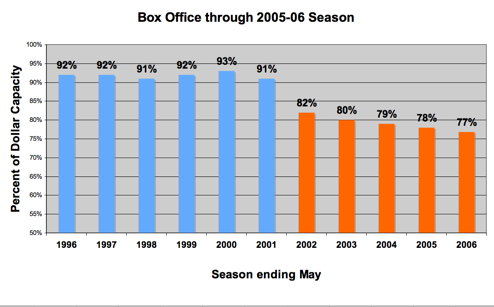
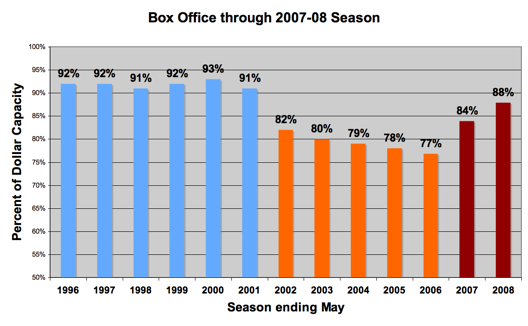
Decline in the box office: We enjoyed virtual sold-out houses (blue bars) in the 1990s. Then, beginning in 2001-2002, the box office dropped steadily, bottoming at 77% of capacity (orange bars) in 2005-06.
Decline in sell-outs: The house was no longer selling out at it was in the 1990s. By 2006, only 10% of the performances sold out.
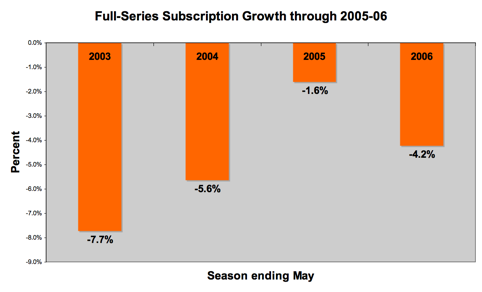
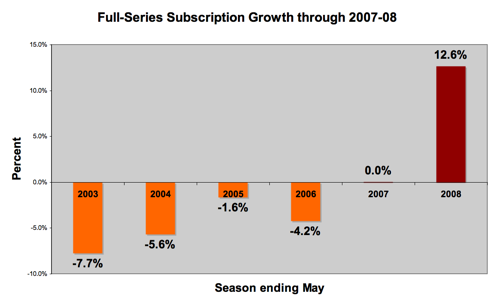
Subscription decline: As a final measure of the deteriorating situation, subscription growth had turned negative. For four straight years through 2005-06, the number of full-series subscribers declined. This meant that more effort had to be poured into selling single tickets, with the requisite additional advertising costs.
Turning the battleship around
To turn the ship around – i.e., fill the house -- three major initiatives were undertaken: (1) improve the product, (2) create a major marketing effort, and (3) add new sources of revenues and audience development.
(1) Improve the Product
The Met product has always operated at a very high artistic level, and particularly on the musical side. But there was still room for improvement on a variety of fronts.
Singers: Stars sell. The Met has always attracted the biggest stars in the world, but often they wouldn’t agree stay for the entire run of an opera series. A diva might perform in two or three performances of an eight-performance run. Then, a less-compelling replacement would fill out the run. That is changing. More of the world’s best artists are now being signed to appear in more operas, and in more appearances per opera.
In return, the Met is beginning to actively promote the stars. For example, in the last two seasons, the images of superstars Anna Netrebko and Natalie Dessay were featured all year in advertising, brochures, tickets, bus signs, telephone kiosks – you name it, their faces were all over New York City. Next season will be Renée Fleming’s turn.

Renée Fleming
Directors and set designers and costumers: To enliven the visual experience, the Met is hiring more directors from the theatrical and film worlds. For example, Anthony Minghella (Madame Butterfly), Bartlett Sher (Barber of Seville), Jack O’Brien (Il Trittico), John Doyle (Peter Grimes), Mary Zimmerman (Lucia di Lammermoor) and others have already directed operas in the last two seasons. Similarly, imaginative new set designers and costumers are being hired to help make the visual impact as exciting as the musical experience. Look, for example, at the spectacular visual effects from the recent Satyagraha production:
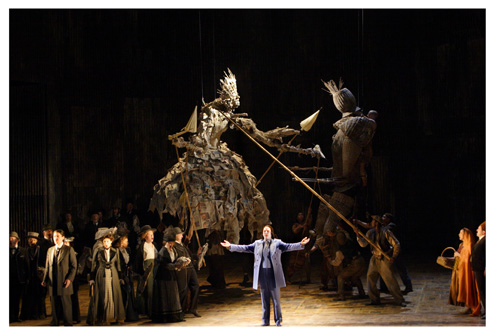
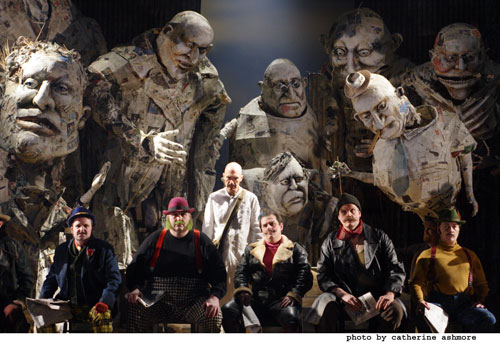
Satyagraha scenes, 2007-08 season
Acting: Concomitant with the above changes, more attention being paid to the acting side. There is a palpable movement away from overweight, immobile singers who “park and bark” to those whose acting ability is commensurate with their singing talents. Anyone lucky enough to have seen Natalie Dessay in La Fille du Regiment saw one of the great comic acting performances of our time. Or Anna Netrebko in any of her performances of the last two years that combined her incredible vocal talents with an astonishing theatrical capability.

Natalie Dessay
Conductors: Other initiatives include the hiring of more world-class conductors to perform when the Met’s music director, James Levine, is not in the house. Levine conducts only 50 or so performances per year, leaving 170 or so to be handled by other conductors.
It's important to note that all this is being done without sacrificing the artistic mission of the Met. It would have been easy, for example, simply to program a full season of audience pleasers and ignore the more obscure or contemporary or challenging works that are so hard to sell. But the Met always has presented, and will continue to present, a complete spectrum of great opera, a range that includes contemporary works as well as less familiar older ones.
But contemporary and obscure operas could be a financial disaster unless a sophisticated marketing effort were in place to create demand. These days, it's no longer financially acceptable to tolerate a half-empty house for a less-accessible work, as has been the case for many years. So that’s what leads us into the next major initiative – marketing.
(2) Create a Major Marketing Effort
Rule One of marketing is, Great marketing starts with a great product. Rule Two is, See Rule One. As noted above, the overriding effort of management is to make the entire opera experience better than it has ever been. Once that has been achieved, marketing can go to work and help fill the house. But if the product isn’t any good, no amount of marketing can make it succeed. As Bill Bernbach, the founder of legendary advertising agency Doyle Dane Bernbach said, “Good advertising makes a bad product fail faster.”
Until two years ago, the Met was essentially a marketing-free organization. How that has changed! A first-class department has been created, with the advertising and public relations efforts revivified, and the website upgraded. The upshot is that the list of new marketing initiatives in the last 24 months is almost endless: Times Square opening-night live telecasts, opera sets displayed in Saks Fifth Avenue windows, red carpet opening nights, free opening-performance dress rehearsals, creation of an art gallery, and Met signs and banners and posters everywhere.
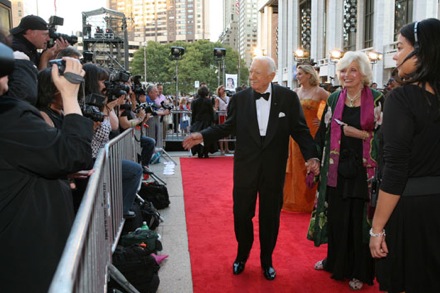
Walter Cronkite on the opening-night red carpet
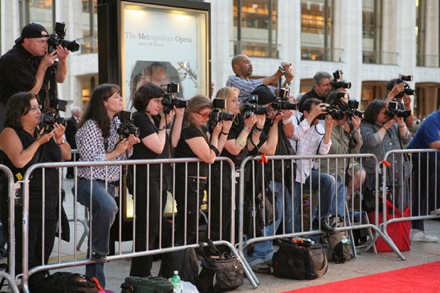
Paparazzi out in force -- this is the Met?
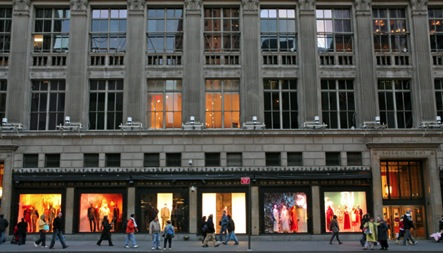
Replicas of Met Opera sets at Saks Fifth Avenue
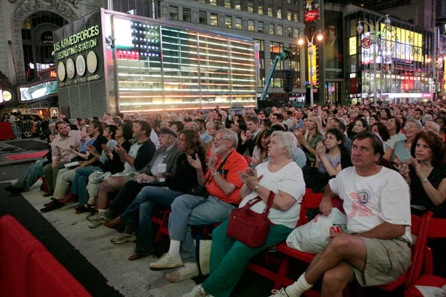
Opening-night audience -- live at Times Square
Gallery Met was opened in a corner of the Met lobby to display commissioned as well as existing works by artists who have been recruited to forge a close relationship with the Met. The hope is to rekindle an alliance between the performing and visual arts. At one time David Hockney, Marc Chagall and other artists were involved in set design for the Met. Perhaps one day some of the artists now exhibiting at Gallery Met will contribute their talents to new productions.
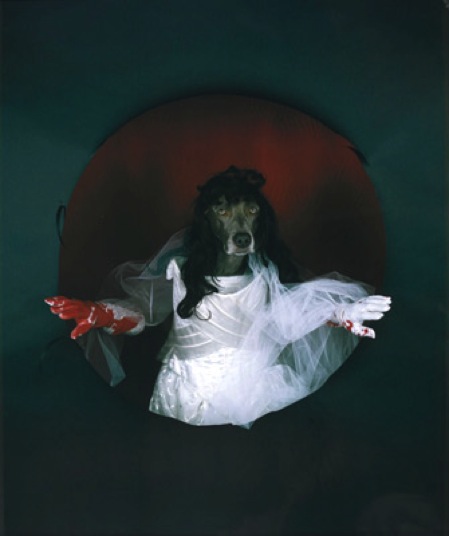
William Wegman Polaroid rendition of Lucia de Lammemoor
An example from the past season, the marketing of Satyagraha, illustrates how inspired marketing can work. Philip Glass's work is, for many, an acquired taste. If you add to that hurdle the fact that the Satyagraha libretto is written entirely in Sanskrit and that Met Titles are not used during the performance, it provides a marketing challenge of the highest level.
As the 2007-08 season began, here’s what happened: Seven performances of Satyagraha was scheduled for the spring of 2008. Many subscribers who found Satyagraha included in their series decided to opt out of the Glass opera -- they traded in their seats for other operas. And single-ticker buyers turned out to be equally cool to the prospect of watching a Sanskrit work. Normally, as a season progresses, single-ticket sales start out filling up the house. But a funny thing happened in this case. The forecasted box office of Satyagraha started declining, and at an alarming rate. The more time that passed, the worse the box office ahead looked. If this continued, there was a chance the opera would play to near-empty houses.
So a marketing task force was put together. For a modest budget, aided by contributions from a board member, the team was able to create dozens of different marketing initiatives designed to attract specialized audiences. New-age magazines yoga groups, anti-apartheid organizations, India groups, South African organizations, et al.
It worked. By the end of its run, Satyagraha had sold out its run. (By the way, it was a terrific production. I like to quip that Satyagraha is now my favorite Sanskrit opera.) Next year, the same team will have an opportunity to apply its narrow-focus marketing techniques to selling the John Adams opera, Doctor Atomic -- a contemporary work about the creation of the atomic bomb.
(3) Generate New Sources of Revenues and Audience Development
The final and most exciting major initiative began two years ago -- live high-definition telecasts to theaters around the world. For 77 years, the Met has broadcast Saturday matinees performances to 11 million radio listeners in 42 countries. But, strangely, the Met actually has to pay many of the radio stations around the world to carry the broadcasts -- fees that amount to millions of dollars annually. (The irony of non-profit radio –- the Met owns the content, but has to pay to have its content broadcast!) Fortunately these radio broadcast costs have been underwritten by major corporate contributors (originally and for many years Texaco; for the last two years Toll Brothers, foundations and others).
With television, however, the economics are different from radio. The new HD telecasts cost on the order of $1 million each to produce and televise worldwide. They are shown in movie theaters that are equipped with satellite links and high definition projectors. But unlike radio, it's the the viewers who pay for the privilege of watching.
In the first season, 2006-07, six operas were telecast to about 325,000 viewers (these numbers include encore, non-live, repeat telecasts). This past season, eight operas were watched by 920,000 people in 23 countries who paid an average of $22 each. The Met splits the receipsix operas were telecast to about 325,000 viewers. Next year, eleven operas will be televised to an even larger number of screens and viewers.
The benefits of this initiative are potentially dramatic, for several reasons. First, revenues just about covered costs in the 2007-08 season; next year revenues should easily exceed costs, and thus become a contributor to the bottom line. Second, it is a terrific source of audience development. After just two years, more people now watch the Met Opera in movie theaters that in the opera house itself (around 850,000). Presumably many of the attendees will graduate from watching the opera in a movie theater to experiencing it at the Metropolitan Opera House. And finally, the HD program is public relations bonanza. The performances are covered by the local media in cities around the world as if the operas were actually held in those locales. The press clip file of the Met now has grown from magazine thickness to that of a telephone book.
The experience of watching an HD live telecast of the Met Opera is remarkable. In many ways it is an improvement over seeing the opera in person. Heresy? No, not really. To start with, the close-ups of the singers on the screen are simply not available in the opera house. Also unique are the live interviews with the performers during intermissions; many are caught just as the curtain falls and they head backstage. Or they're interviewed in their dressing rooms. And the specially produced documentaries shown during intermission -– for example, how the opera was rehearsed -– are insightful. Moreover, the high-definition images, color, and sound are all at the highest level. (Well, almost always. There have been times when the theater's equipment crashed, or went out of adjustment, or whatever. But, hey, they're still early on the learning curve.). Oh, and a final note of differentiation -- you can munch popcorn during the performance.
By the way, even though the telecasts are shown a month or so later on PBS, there is simply no comparison between seeing them in the theater and on a home TV system -- the giant screen imparts a totally different experience.
Needless to say, the Met’s HD telecasts have been so successful that they have attracted competition. Already, La Scala and the San Francisco Opera have begun transmitting a limited number of their productions to theaters -- butnot live. Their results so far have been dismal. A recent showing of a San Francisco Opera telecast in a New York theater had three people in the audience. By contrast, the Met’s theaters are mostly sold out, and many of the theaters have added additional screens to accommodate the crowds.
The HD telecasts have created a salutary byproduct. It may be my imagination, or it may be real, but the singers at the Met, both male and female, seem to be getting slimmer. It’s one thing to be a plus-size on the stage, but having one's one’s image projected around the world on forty-foot-wide screens makes even the most confident superstar head for the gym.
Measures of success
Well, it’s been two years now since the Met embarked on its new initiatives. What are the results? Here are three measures of success: box office, sell-outs, and subscription rates.
Box office improving strongly
The box office results for the last two years showed a dramatic improvement, rising seven points to 84% in 2006-07 and a further four points to 88% last year (maroon bars). Because each percentage point translates into roughly $1 million of revenue, the uplift to the Met bottom line is meaningful.
(These box office figures are for percentage of total dollar capacity. The actual number of seats filled is about six percentage points higher, or very close to 100% capacity. At every performance there are some discount seats and complimentary seats.)
Sell-outs increasing rapidly
The second measure of success can be seen in the chart below on sold-out houses. After year-by-year declines earlier in the decade, sell-outs fell to a low of 10% in 2005-06. But just two years later, 58% of the season's performances sold out.
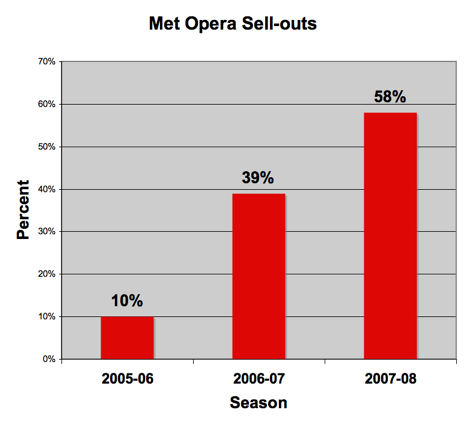
Besides the revenue impact of selling out the house, there are other important benefits. Sell-outs create buzz and excitement. It stimulates both the performers and the audience to see every seat in the house occupied. Sell-outs add to pricing strength. And, of course, everyone wants to go to a show that he can’t get tickets to. Finally, sell-outs are a boon for selling subscriptions and for increasing philanthropy. For a number of years, when you could buy a ticket for just about any performance at any time, there was diminished incentive to subscribe or to make a donation. That's no longer the case; if you don’t have a subscription, you may not have a chance to see the show you want. And now, these pressures increase the likelihood of donations in the hopes of getting better seats or subscriptions.
Subscriptions growing
In the early years of the decade, the number of full-series subscribers were diminishing. Because of little incentive to subscribe – tickets were freely available last minute – subscription levels declined every year (orange bars). That all changed in 2006-07, when subscription levels stopped dropping. Then, in 2007-08, full-series subscriptions rose 12.6% (maroon bar). Few other cultural organizations have shown that much growth in subscriptions in recent years, and fewer still double-digit growth.
Case Study Conclusion: The Battleship Has Turned
There seems to be enough data now to demonstrate that the Battleship Met has indeed turned around. Just two years ago, every indicator for the Met Opera was pointing down. And now they’re all pointing up -- attendance, subscriptions, sellouts, philanthropy. And if one looks at that ephemeral quality associated with success -- buzz -- the Met now has it again. In fact, the Met has become the hot cultural ticket in town.
Yes, it’s costing more money to effect these changes, but the increases in revenues -- from philanthropy, box office, and telecasts – are likely to offset these costs in the future.
Even though opera is an anachronism, a centuries-old art form replete with some of the creakiest plots imaginable, in 2008 opera – at least the Met Opera-- is where the action is. The Met has begun a new act. Who woulda thunk it?
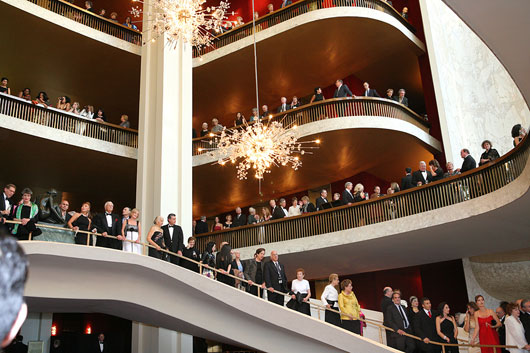
Opening night at the Met, 2007-08 season
Three years ago, renowned artists Christo and Jeanne-Claude electrified the art world -- and particularly New York City -- with their creation of The Gates in Central Park. Like all their previous large installations, The Gates was on display for only a limited time (16 days), and then it was dismantled and destroyed -- all 7,503 gates and their saffron-colored fabric panels. Only the memory -- and millions of photos -- remain.
For me, the work had an impact beyond its artistic one; it provided me with the subject of my very first video not involving grandchildren. Now I love my three grandchildren, but if this septuagenarian fashions himself as the Grandma Moses of the film-making world, he has to engage in subjects of more provocative interest than his children's children, however engaging the little tykes are.
So five days before the Feb. 12, 2005, opening of The Gates, I took my little camcorder down to the park and started shooting. I kept shooting until the last gate was dismantled. I then taught myself rudimentary video editing and scoring a video. The final result turned out to be pretty much as you would guess -- amateurish but earnest.
Undiscouraged and certainly not bowed, I have since moved on to larger and more professional high-definition camera equipment, immersed myself in powerful editing software, and and am ready now to write, direct, edit and score my magnum opus. Except for one thing. I'm lacking a story as compelling as The Gates. So until I find its equal, I'll have to settle right here for sharing with you My First Video -- The Gates. Click on the link below to see the six-minute video:
The Gates Video -- click here
And following are a few of the hundreds of still photographs I took of The Gates.


Day One of Barack Obama as the Democratic nominee, and we were fortunate enough to have had dinner with him last evening. Fresh from his victory speech in St. Paul and a day in Washington, D.C., at the Senate and at AIPAC, the Senator arrived at the fund-raiser in a private Manhattan home to greet and dine and thank and schmooze with a hundred supporters who contributed a lot of money to have dinner with him.
Background: Last May 3, 2007, we hosted our own fund-raiser for him in our apartment as the campaign was still in its embryonic stages. It was the first day of Secret Service protection, and that consisted of a solitary agent (the security contingent is a lot larger now). The candidate then was energetic, engaged, and chatted up each of our fifty guests. And as I blogged at the time, the difference I noticed immediately between him and Bill Clinton, whom I had met once, was that in conversation, Clinton lectured; Obama listened.
He's a phenomenon: Obama has been campaigning nonstop since then, every day, up to 18 hours per day, God knows how many states, cities, burgs, railroad crossings, shopping centers, bowling alleys and doughnut shops. Yet tonight he arrived fresh, involved, enthusiastic - and mesmerizing. After brief introductory remarks, he circulated around the room, speaking with each attendee, recognizing most of them, and giving new meaning to gracious.
What wasn't said: Who his VP choice is, who his cabinet appointments will be, and whom he'll put on the Supreme Court. (Surprise!)
Who was in the audience: You know -- the usual suspects. Not exactly the demographic of Kentucky or West Virginia, rather his long-time supporters, a few new recruits, and a lot of the faithful. But what took me aback was the presence of at least two hitherto - until yesterday -- strong supporters of Hillary Clinton, and at least one with the (perhaps dashed) hopes of scoring a top cabinet post in a Clinton administration. This attendee's presence signifies either that the rapprochement has begun, or that opportunism is alive and well and living in politics. (Surprise, surprise!)
VP discussion: In a highly unscientific poll that I conducted of a smattering of the guests, the support for Hillary as the running mate was zero. (Surprise, surprise, surprise!)
What it proved: There is a big pool of money out there available for Obama that extends well beyond the Internet machine that has proved so successful in his campaign. And unlike the primary cycle, where there was a $2,300 limit per person, the creative minds of the political world have found ingenious ways to multiply that upper limit more than ten-fold for the general election. So fund-raising dinners that once netted six-figure amounts have moved into seven-figure territory.
What we came away with: That we were witnessing history. That we were in the presence of a person who can unify the country, both politically and racially. Someone who can return us to the family of nations. And someone who can once again make us feel proud to call ourselves Americans. That is why we attended the event where the bill for dinner was, shall we say, high, even by Manhattan restaurant standards.


