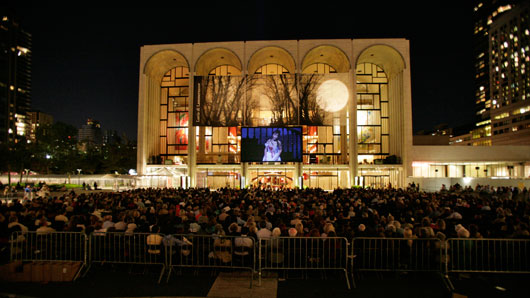
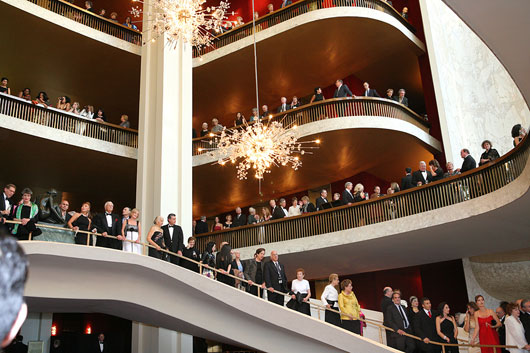
Opening night at the Met, 2007-08 season
Okay class, pay attention. Here’s today's business problem:
It’s 2006. You’re hired to run the largest performing arts organization in the world, a 125-year-old household name. Every year, you stage over 200 performances per year of a couple of dozen different operas. Your performances are heard by millions of radio listeners around the world. And until the year 2000, your ticket was the hardest to score in New York City.
But in the last six years, everything’s gone awry. Attendance has declined sharply. Costs have risen every year. Philanthropic contributions have flattened out. The endowment is woefully inadequate. Competition for the cultural dollar is soaring. There are signs of organizational complacency. And even though your audience is disappearing, you have no marketing organization in place to try to offset the decline.
What to do? Can anything be done? Is there a solution?
Well, in fact, this would indeed make a splendid business-school case study. And a much more interesting one than the run of corporate cases that MBA students are challenged with.
The dire situation outlined above is not hypothetical; it’s real. It’s what faced the Metropolitan Opera just two years ago. A little background:
In the 1990s, the Met essentially sold out the house every night. The 4,000-seat theater was filled seven times per week for over thirty weeks per year. Every night a different opera. Costs rose every year, but they were offset by the ability to raise ticket prices with impunity. Philanthropy was healthy, so the lack of a healthy endowment was not an issue. Also unimportant was the lack of a marketing team -– no need to create demand when almost every performance sells out.
Then came the millennium, and everything changed, and for the worse -– attendance, philanthropy, competition, subscriptions, and the bottom line. There are a lot of reasons for this collapse. For the Met it was a virtual perfect storm. Early in the decade, a recession began. Then 9/11 rocked the world. This tragedy, in turn, adversely affected travel, cutting down sharply visits by domestic and international opera-goers.
Customers began to resist the high price of attending an opera. And changes in lifestyle caused the subscription rate to fall -- less planning in advance, more spontaneous ticket-buying. As subscription-ticket sales fell, they had to be offset by single-ticket purchasers; single-ticket sales require expensive advertising campaigns. The aging audience was not being replaced by younger attendees. And the standard repertory of familiar operas by Verdi, Puccini, Mozart, et al., could no longer be counted on to fill the house automatically, at least not without megastars singing the major roles.
Moreover, this century-old dowager was getting a little dowdy, a little ragged around the edges, a little stodgy, and reluctant to change with the times. Then, in 2004, its longtime general manager, Joe Volpe, announced his desire to retire within two years.
The Met board, of which I was a member at the time, initiated a search for a new general manager, and I was appointed chairman of the search committee. (I retired from the board last year, but continue to serve as chairman of the marketing committee.) After a seven-month search, we selected Peter Gelb, former CEO of Sony Classical, as our choice to manage the Met, and the full board unanimously approved our choice.
Gelb served a year and a half as general-manager designate, working closely with Volpe, and then officially began running the show at the start of the 2006-07 season. (The seasons run from September through May.) Because operas are planned as many as four years in advance, the programming and total impact of the new administration will not be fully realized until the 2009-10 season. Yet starting with his first season, some changes were able to be made to the repertory –- a few new productions shoe-horned in, a director change here, a new singer there, a set designer change here. This process continued into the just-ended 2007-08 season, and more changes will be realized next year. By 2009-10,Gelb and his team will have full responsibility for the entire season’s repertory –- as well as for the overall results of the organization.
Although Gelb had never run an opera house before, he knew a lot about dealing with artistic talent (having spent a large portion of his career in artists’ management). But what really appealed to the selection committee and to the board was his marketing flair. And if ever an organization needed marketing, it was the Metropolitan Opera. Here's why:
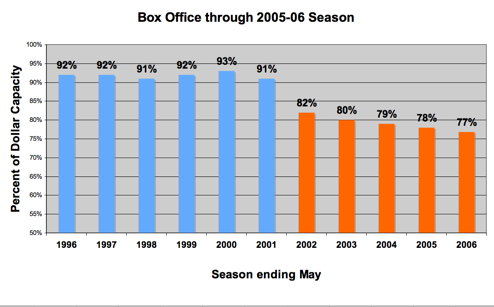
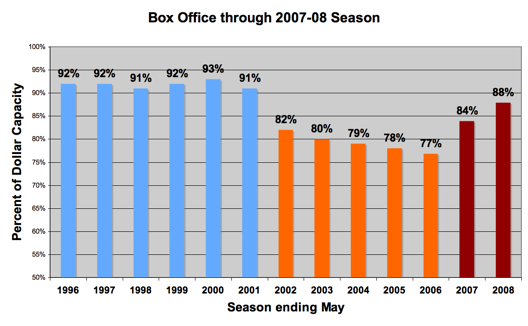
Decline in the box office: We enjoyed virtual sold-out houses (blue bars) in the 1990s. Then, beginning in 2001-2002, the box office dropped steadily, bottoming at 77% of capacity (orange bars) in 2005-06.
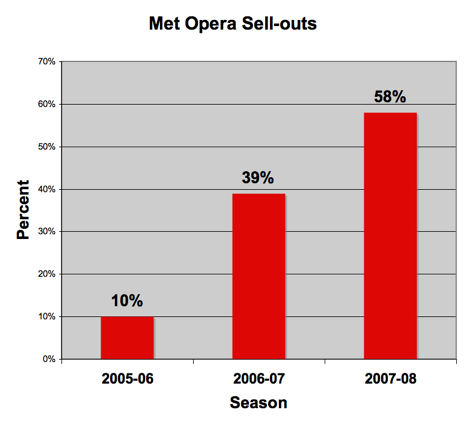
Decline in sell-outs: The house was no longer selling out at it was in the 1990s. By 2006, only 10% of the performances sold out.
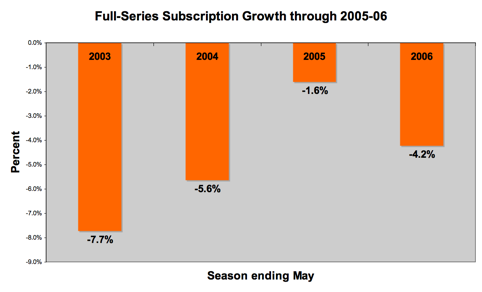
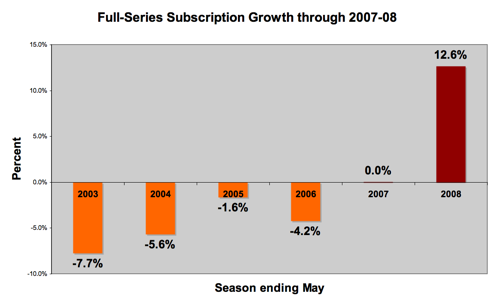
Subscription decline: As a final measure of the deteriorating situation, subscription growth had turned negative. For four straight years through 2005-06, the number of full-series subscribers declined. This meant that more effort had to be poured into selling single tickets, with the requisite additional advertising costs.
Turning the battleship around
To turn the ship around – i.e., fill the house -- three major initiatives were undertaken: (1) improve the product, (2) create a major marketing effort, and (3) add new sources of revenues and audience development.
(1) Improve the Product
The Met product has always operated at a very high artistic level, and particularly on the musical side. But there was still room for improvement on a variety of fronts.
Singers: Stars sell. The Met has always attracted the biggest stars in the world, but often they wouldn’t agree stay for the entire run of an opera series. A diva might perform in two or three performances of an eight-performance run. Then, a less-compelling replacement would fill out the run. That is changing. More of the world’s best artists are now being signed to appear in more operas, and in more appearances per opera.
In return, the Met is beginning to actively promote the stars. For example, in the last two seasons, the images of superstars Anna Netrebko and Natalie Dessay were featured all year in advertising, brochures, tickets, bus signs, telephone kiosks – you name it, their faces were all over New York City. Next season will be Renée Fleming’s turn.

Renée Fleming
Directors and set designers and costumers: To enliven the visual experience, the Met is hiring more directors from the theatrical and film worlds. For example, Anthony Minghella (Madame Butterfly), Bartlett Sher (Barber of Seville), Jack O’Brien (Il Trittico), John Doyle (Peter Grimes), Mary Zimmerman (Lucia di Lammermoor) and others have already directed operas in the last two seasons. Similarly, imaginative new set designers and costumers are being hired to help make the visual impact as exciting as the musical experience. Look, for example, at the spectacular visual effects from the recent Satyagraha production:
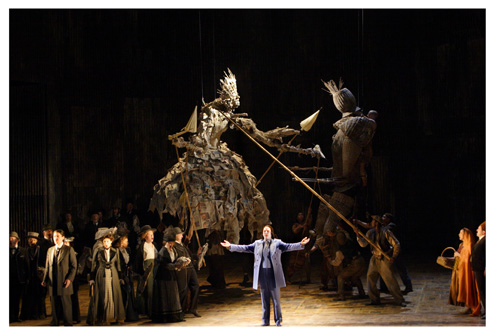
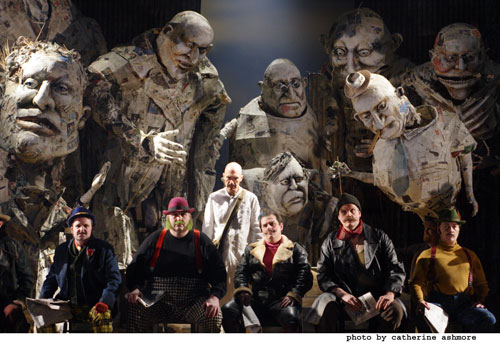
Satyagraha scenes, 2007-08 season
Acting: Concomitant with the above changes, more attention being paid to the acting side. There is a palpable movement away from overweight, immobile singers who “park and bark” to those whose acting ability is commensurate with their singing talents. Anyone lucky enough to have seen Natalie Dessay in La Fille du Regiment saw one of the great comic acting performances of our time. Or Anna Netrebko in any of her performances of the last two years that combined her incredible vocal talents with an astonishing theatrical capability.

Natalie Dessay
Conductors: Other initiatives include the hiring of more world-class conductors to perform when the Met’s music director, James Levine, is not in the house. Levine conducts only 50 or so performances per year, leaving 170 or so to be handled by other conductors.
It's important to note that all this is being done without sacrificing the artistic mission of the Met. It would have been easy, for example, simply to program a full season of audience pleasers and ignore the more obscure or contemporary or challenging works that are so hard to sell. But the Met always has presented, and will continue to present, a complete spectrum of great opera, a range that includes contemporary works as well as less familiar older ones.
But contemporary and obscure operas could be a financial disaster unless a sophisticated marketing effort were in place to create demand. These days, it's no longer financially acceptable to tolerate a half-empty house for a less-accessible work, as has been the case for many years. So that’s what leads us into the next major initiative – marketing.
(2) Create a Major Marketing Effort
Rule One of marketing is, Great marketing starts with a great product. Rule Two is, See Rule One. As noted above, the overriding effort of management is to make the entire opera experience better than it has ever been. Once that has been achieved, marketing can go to work and help fill the house. But if the product isn’t any good, no amount of marketing can make it succeed. As Bill Bernbach, the founder of legendary advertising agency Doyle Dane Bernbach said, “Good advertising makes a bad product fail faster.”
Until two years ago, the Met was essentially a marketing-free organization. How that has changed! A first-class department has been created, with the advertising and public relations efforts revivified, and the website upgraded. The upshot is that the list of new marketing initiatives in the last 24 months is almost endless: Times Square opening-night live telecasts, opera sets displayed in Saks Fifth Avenue windows, red carpet opening nights, free opening-performance dress rehearsals, creation of an art gallery, and Met signs and banners and posters everywhere.
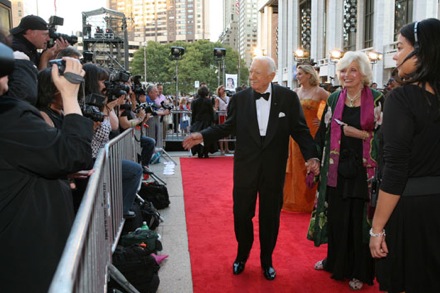
Walter Cronkite on the opening-night red carpet
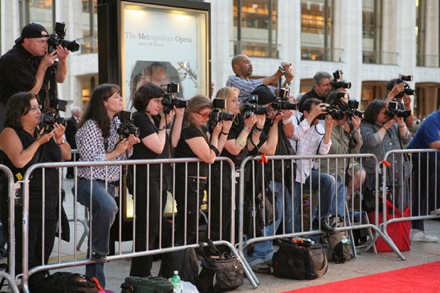
Paparazzi out in force -- this is the Met?
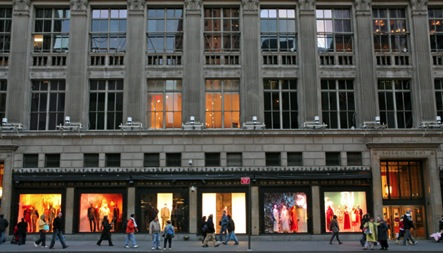
Replicas of Met Opera sets at Saks Fifth Avenue
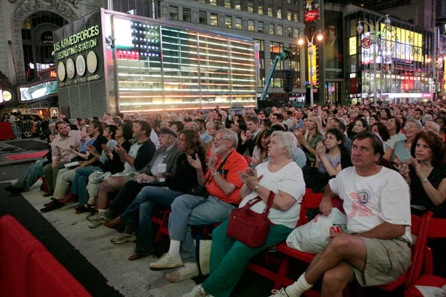
Opening-night audience -- live at Times Square
Gallery Met was opened in a corner of the Met lobby to display commissioned as well as existing works by artists who have been recruited to forge a close relationship with the Met. The hope is to rekindle an alliance between the performing and visual arts. At one time David Hockney, Marc Chagall and other artists were involved in set design for the Met. Perhaps one day some of the artists now exhibiting at Gallery Met will contribute their talents to new productions.
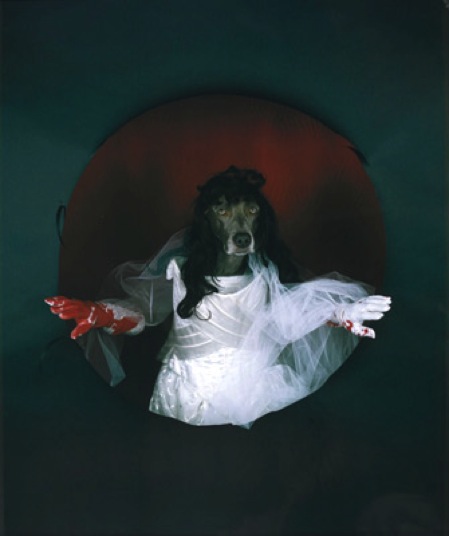
William Wegman Polaroid rendition of Lucia de Lammemoor
An example from the past season, the marketing of Satyagraha, illustrates how inspired marketing can work. Philip Glass's work is, for many, an acquired taste. If you add to that hurdle the fact that the Satyagraha libretto is written entirely in Sanskrit and that Met Titles are not used during the performance, it provides a marketing challenge of the highest level.
As the 2007-08 season began, here’s what happened: Seven performances of Satyagraha was scheduled for the spring of 2008. Many subscribers who found Satyagraha included in their series decided to opt out of the Glass opera -- they traded in their seats for other operas. And single-ticker buyers turned out to be equally cool to the prospect of watching a Sanskrit work. Normally, as a season progresses, single-ticket sales start out filling up the house. But a funny thing happened in this case. The forecasted box office of Satyagraha started declining, and at an alarming rate. The more time that passed, the worse the box office ahead looked. If this continued, there was a chance the opera would play to near-empty houses.
So a marketing task force was put together. For a modest budget, aided by contributions from a board member, the team was able to create dozens of different marketing initiatives designed to attract specialized audiences. New-age magazines yoga groups, anti-apartheid organizations, India groups, South African organizations, et al.
It worked. By the end of its run, Satyagraha had sold out its run. (By the way, it was a terrific production. I like to quip that Satyagraha is now my favorite Sanskrit opera.) Next year, the same team will have an opportunity to apply its narrow-focus marketing techniques to selling the John Adams opera, Doctor Atomic -- a contemporary work about the creation of the atomic bomb.
(3) Generate New Sources of Revenues and Audience Development
The final and most exciting major initiative began two years ago -- live high-definition telecasts to theaters around the world. For 77 years, the Met has broadcast Saturday matinees performances to 11 million radio listeners in 42 countries. But, strangely, the Met actually has to pay many of the radio stations around the world to carry the broadcasts -- fees that amount to millions of dollars annually. (The irony of non-profit radio –- the Met owns the content, but has to pay to have its content broadcast!) Fortunately these radio broadcast costs have been underwritten by major corporate contributors (originally and for many years Texaco; for the last two years Toll Brothers, foundations and others).
With television, however, the economics are different from radio. The new HD telecasts cost on the order of $1 million each to produce and televise worldwide. They are shown in movie theaters that are equipped with satellite links and high definition projectors. But unlike radio, it's the the viewers who pay for the privilege of watching.
In the first season, 2006-07, six operas were telecast to about 325,000 viewers (these numbers include encore, non-live, repeat telecasts). This past season, eight operas were watched by 920,000 people in 23 countries who paid an average of $22 each. The Met splits the receipsix operas were telecast to about 325,000 viewers. Next year, eleven operas will be televised to an even larger number of screens and viewers.
The benefits of this initiative are potentially dramatic, for several reasons. First, revenues just about covered costs in the 2007-08 season; next year revenues should easily exceed costs, and thus become a contributor to the bottom line. Second, it is a terrific source of audience development. After just two years, more people now watch the Met Opera in movie theaters that in the opera house itself (around 850,000). Presumably many of the attendees will graduate from watching the opera in a movie theater to experiencing it at the Metropolitan Opera House. And finally, the HD program is public relations bonanza. The performances are covered by the local media in cities around the world as if the operas were actually held in those locales. The press clip file of the Met now has grown from magazine thickness to that of a telephone book.
The experience of watching an HD live telecast of the Met Opera is remarkable. In many ways it is an improvement over seeing the opera in person. Heresy? No, not really. To start with, the close-ups of the singers on the screen are simply not available in the opera house. Also unique are the live interviews with the performers during intermissions; many are caught just as the curtain falls and they head backstage. Or they're interviewed in their dressing rooms. And the specially produced documentaries shown during intermission -– for example, how the opera was rehearsed -– are insightful. Moreover, the high-definition images, color, and sound are all at the highest level. (Well, almost always. There have been times when the theater's equipment crashed, or went out of adjustment, or whatever. But, hey, they're still early on the learning curve.). Oh, and a final note of differentiation -- you can munch popcorn during the performance.
By the way, even though the telecasts are shown a month or so later on PBS, there is simply no comparison between seeing them in the theater and on a home TV system -- the giant screen imparts a totally different experience.
Needless to say, the Met’s HD telecasts have been so successful that they have attracted competition. Already, La Scala and the San Francisco Opera have begun transmitting a limited number of their productions to theaters -- butnot live. Their results so far have been dismal. A recent showing of a San Francisco Opera telecast in a New York theater had three people in the audience. By contrast, the Met’s theaters are mostly sold out, and many of the theaters have added additional screens to accommodate the crowds.
The HD telecasts have created a salutary byproduct. It may be my imagination, or it may be real, but the singers at the Met, both male and female, seem to be getting slimmer. It’s one thing to be a plus-size on the stage, but having one's one’s image projected around the world on forty-foot-wide screens makes even the most confident superstar head for the gym.
Measures of success
Well, it’s been two years now since the Met embarked on its new initiatives. What are the results? Here are three measures of success: box office, sell-outs, and subscription rates.
Box office improving strongly
The box office results for the last two years showed a dramatic improvement, rising seven points to 84% in 2006-07 and a further four points to 88% last year (maroon bars). Because each percentage point translates into roughly $1 million of revenue, the uplift to the Met bottom line is meaningful.
(These box office figures are for percentage of total dollar capacity. The actual number of seats filled is about six percentage points higher, or very close to 100% capacity. At every performance there are some discount seats and complimentary seats.)
Sell-outs increasing rapidly
The second measure of success can be seen in the chart below on sold-out houses. After year-by-year declines earlier in the decade, sell-outs fell to a low of 10% in 2005-06. But just two years later, 58% of the season's performances sold out.
Besides the revenue impact of selling out the house, there are other important benefits. Sell-outs create buzz and excitement. It stimulates both the performers and the audience to see every seat in the house occupied. Sell-outs add to pricing strength. And, of course, everyone wants to go to a show that he can’t get tickets to. Finally, sell-outs are a boon for selling subscriptions and for increasing philanthropy. For a number of years, when you could buy a ticket for just about any performance at any time, there was diminished incentive to subscribe or to make a donation. That's no longer the case; if you don’t have a subscription, you may not have a chance to see the show you want. And now, these pressures increase the likelihood of donations in the hopes of getting better seats or subscriptions.
Subscriptions growing
In the early years of the decade, the number of full-series subscribers were diminishing. Because of little incentive to subscribe – tickets were freely available last minute – subscription levels declined every year (orange bars). That all changed in 2006-07, when subscription levels stopped dropping. Then, in 2007-08, full-series subscriptions rose 12.6% (maroon bar). Few other cultural organizations have shown that much growth in subscriptions in recent years, and fewer still double-digit growth.
Case Study Conclusion: The Battleship Has Turned
There seems to be enough data now to demonstrate that the Battleship Met has indeed turned around. Just two years ago, every indicator for the Met Opera was pointing down. And now they’re all pointing up -- attendance, subscriptions, sellouts, philanthropy. And if one looks at that ephemeral quality associated with success -- buzz -- the Met now has it again. In fact, the Met has become the hot cultural ticket in town.
Yes, it’s costing more money to effect these changes, but the increases in revenues -- from philanthropy, box office, and telecasts – are likely to offset these costs in the future.
Even though opera is an anachronism, a centuries-old art form replete with some of the creakiest plots imaginable, in 2008 opera – at least the Met Opera-- is where the action is. The Met has begun a new act. Who woulda thunk it?
Opening night at the Met, 2007-08 season
Three years ago, renowned artists Christo and Jeanne-Claude electrified the art world -- and particularly New York City -- with their creation of The Gates in Central Park. Like all their previous large installations, The Gates was on display for only a limited time (16 days), and then it was dismantled and destroyed -- all 7,503 gates and their saffron-colored fabric panels. Only the memory -- and millions of photos -- remain.
For me, the work had an impact beyond its artistic one; it provided me with the subject of my very first video not involving grandchildren. Now I love my three grandchildren, but if this septuagenarian fashions himself as the Grandma Moses of the film-making world, he has to engage in subjects of more provocative interest than his children's children, however engaging the little tykes are.
So five days before the Feb. 12, 2005, opening of The Gates, I took my little camcorder down to the park and started shooting. I kept shooting until the last gate was dismantled. I then taught myself rudimentary video editing and scoring a video. The final result turned out to be pretty much as you would guess -- amateurish but earnest.
Undiscouraged and certainly not bowed, I have since moved on to larger and more professional high-definition camera equipment, immersed myself in powerful editing software, and and am ready now to write, direct, edit and score my magnum opus. Except for one thing. I'm lacking a story as compelling as The Gates. So until I find its equal, I'll have to settle right here for sharing with you My First Video -- The Gates. Click on the link below to see the six-minute video:
The Gates Video -- click here
And following are a few of the hundreds of still photographs I took of The Gates.


Day One of Barack Obama as the Democratic nominee, and we were fortunate enough to have had dinner with him last evening. Fresh from his victory speech in St. Paul and a day in Washington, D.C., at the Senate and at AIPAC, the Senator arrived at the fund-raiser in a private Manhattan home to greet and dine and thank and schmooze with a hundred supporters who contributed a lot of money to have dinner with him.
Background: Last May 3, 2007, we hosted our own fund-raiser for him in our apartment as the campaign was still in its embryonic stages. It was the first day of Secret Service protection, and that consisted of a solitary agent (the security contingent is a lot larger now). The candidate then was energetic, engaged, and chatted up each of our fifty guests. And as I blogged at the time, the difference I noticed immediately between him and Bill Clinton, whom I had met once, was that in conversation, Clinton lectured; Obama listened.
He's a phenomenon: Obama has been campaigning nonstop since then, every day, up to 18 hours per day, God knows how many states, cities, burgs, railroad crossings, shopping centers, bowling alleys and doughnut shops. Yet tonight he arrived fresh, involved, enthusiastic - and mesmerizing. After brief introductory remarks, he circulated around the room, speaking with each attendee, recognizing most of them, and giving new meaning to gracious.
What wasn't said: Who his VP choice is, who his cabinet appointments will be, and whom he'll put on the Supreme Court. (Surprise!)
Who was in the audience: You know -- the usual suspects. Not exactly the demographic of Kentucky or West Virginia, rather his long-time supporters, a few new recruits, and a lot of the faithful. But what took me aback was the presence of at least two hitherto - until yesterday -- strong supporters of Hillary Clinton, and at least one with the (perhaps dashed) hopes of scoring a top cabinet post in a Clinton administration. This attendee's presence signifies either that the rapprochement has begun, or that opportunism is alive and well and living in politics. (Surprise, surprise!)
VP discussion: In a highly unscientific poll that I conducted of a smattering of the guests, the support for Hillary as the running mate was zero. (Surprise, surprise, surprise!)
What it proved: There is a big pool of money out there available for Obama that extends well beyond the Internet machine that has proved so successful in his campaign. And unlike the primary cycle, where there was a $2,300 limit per person, the creative minds of the political world have found ingenious ways to multiply that upper limit more than ten-fold for the general election. So fund-raising dinners that once netted six-figure amounts have moved into seven-figure territory.
What we came away with: That we were witnessing history. That we were in the presence of a person who can unify the country, both politically and racially. Someone who can return us to the family of nations. And someone who can once again make us feel proud to call ourselves Americans. That is why we attended the event where the bill for dinner was, shall we say, high, even by Manhattan restaurant standards.

In recent weeks, I came across three essays dealing with the outlook for continued scientific leadership by the United States. An op-ed piece in the April 17 Wall Street Journal by David Baltimore and Ahmed Zewail, both Nobel laureates and professors at Caltech, is pessimistic: “America cannot simply assume its lead in science will continue. In recent years the science community has been starved of the resources it needs. Young, new, energetic scientists are the seed corn of nearly all new scientific development. However, our schools, laboratories and granting agencies all, in one way or another, discourage launching a career in the sciences.
“The National Academy of Sciences issued a report, ‘Rising Above the Gathering Storm,’ that helped drive Congress to pass legislation – the American Competitiveness Initiative – aimed at bolstering the sciences. It was supposed to beef up the study of science in high school. In the end, no money was found to fund the initiative. It was a commitment made, but not kept.
“Our presidential hopefuls should be telling us their positions on critical science issues, but they have not done so yet.”
Reinforcing this view is the Information Technology and Innovation Foundation, which issued a report in April bemoaning the state of innovation in America today. Among the specific challenges the report cited were increasing global competition, a slippage in American innovation leadership, innovation inefficiencies in private markets, and no national innovation policy.
But for at least one person, the glass is half full. Fareed Zakaria has just published a new book, “The Post-American World.” Zakaria, editor of Newsweek International and a keen observer of world geopolitics, is more optimistic. “Indeed, higher education is the United States’ best industry. In no other field is the United States’ advantage so overwhelming… with seven or eight of the world’s top 10 universities.”
So we have two pessimists and one optimist. What should we conclude about the future of science and innovation in the United States? Clearly, it is science that drives innovation, and innovation that drives America’s economic growth and ultimately determines its living standards.
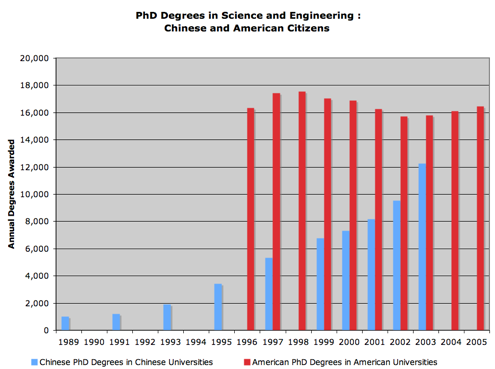
To get an answer to this question, let’s look at the data. One way of measuring the state of our scientific hegemony is to look at the number of Ph.D. degrees in science and engineering that our universities produce each year, and compare those with our newest and biggest competitor, China. As the chart below shows, as of 2003 we were still well ahead -- about 16,000 U.S. citizens received Ph.D.s from U.S. universities versus 12,000 Chinese citizens from Chinese universities. What’s ominous is the rapid growth of Chinese Ph.D. degrees in Chinese universities (the blue bars). Because of the rapid growth of Chinese degrees, I suspect that they’re ahead of us by now.
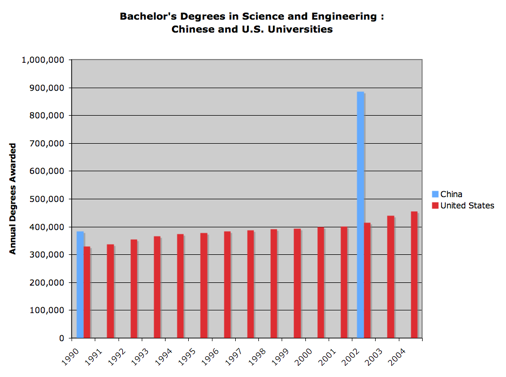
Another measure is the number of bachelor’s degrees in science and engineering from Chinese and American universities. In the last decade the number of Chinese BS degrees has almost doubled those of the US. It is probably true, as Zakaria points out in his book, the way that the Chinese define bachelors degrees is less rigorous than our definition -- they include many who have engaged more in vocational studies than in true four-year university engineering degrees. But however you define them, their numbers are growing rapidly while ours are increasing only modestly.
There is another measure -- the changing priorities in American industrial research and development. During the period from 1991-2003, corporate R&D shifted radically to favor development over basic and applied research. Development is growing at the expense of research, which is declining. In an earlier day, American industry supported some of the great basic and applied research laboratories in the world – Bell Telephone Laboratories, David Sarnoff Laboratory at RCA, General Electric and IBM research laboratories, and many other smaller but very productive centers of basic and applied research.
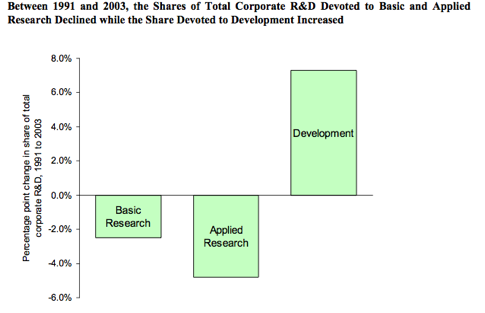
That has all changed. The emphasis in industry in recent decades has been to develop immediate commercial products rather than to win Nobel prizes for science. But because basic and applied research are the progenitors of subsequent development and innovation, we’re losing a great source of international competitiveness. Indeed, virtually all basic research today is funded by the federal government, with the majority of it coming from the National Institutes of Health and the National Science Foundation, both of which have been under severe funding pressure in recent years. In real dollars, NIH funding has been declining.
This final chart reinforces how our global competitiveness is slipping. Using six different measures, the Council on Competitiveness demonstrates how in the last 15 years the US has been losing ground to its international competitors in these drivers of innovation. Perhaps the most dramatic decline is in the number of new American doctorates in science and engineering (right-most bars), which has declined from 52% of the world total to 22%.
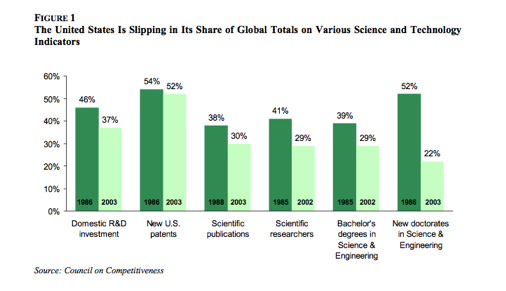
So despite Fareed Zakaria’s optimism about the future of American science and engineering education, it’s clear to me that we are slipping competitively. Basic and applied research are funded almost entirely by the federal government, and the federal government is showing diminishing interest in supporting what is the basis of subsequent innovation. Unless this policy changes with the next administration, it will have a deleterious effect on the American standard of living.
As Baltimore and Zewail point out in their essay, the lack of interest in science is shared by the political candidates of both parties – it’s an equal opportunity tragedy. Neither has said a word on science during the campaign. And it’s true that while science has few votes, it has big implications for our future.
Perhaps we need a wake-up call. In the last century the United States received two scientific wake-up calls that dramatically changed the way the nation looked at the need for science and engineering. World War II stimulated our scientific and technical output as no other development has before or since. And on October 4, 1957, when Sputnik was launched by the Soviet Union, it shocked the United States into a newfound – if short-lived -- interest in reinvigorating our scientific infrastructure.
It would be nice to believe that we could recognize our need today without the necessity of a shock or wake-up call, but it’s hard to be optimistic, particularly given the discouraging level of discourse at the political level. And though I like to look at the world through Rosen-colored glasses, my optimism is being severely tested.
How would you like a feel-good story? A really good one?

Donna and I recently spent ten days in New Orleans where we have an apartment as well as close family members and a host of friends. I spent my first 17 years there, and Donna most of her adult life there running a contemporary art gallery. New Orleans is very close to both of us, and in many ways.
During our visit, we indulged in many of the activities that residents and visitors to New Orleans do. We ate well, both upscale and down (Galatoire’s, Gautreaux, Antoine’s, 1179, Commander’s Palace, Felix, Café Degas, Liuzza’s). We listened to jazz, although on our two attempts to visit JazzFest we were thwarted by thunderstorms. We did manage to hit some of the Frenchmen St. and nearby music joints – Spotted Cat, Snug Harbor, and Saturn Bar. And, of course, there were the dinner parties with friends.
But back in New York, the words "New Orleans" cannot be uttered without immediately being asked, “ How’s the recovery coming along?” The short answer is, “slowly.” The long answer, by definition, takes longer.
Three months after the waters of hurricane Katrina receded, the unflooded part of the city, comprising only about 20% of the land area, was back in business -- the port, much of the commercial area, the French Quarter, the Garden District, a large part of uptown, Tulane University (the city’s largest employer), and a few other areas. Over the last two years, this so-called “sliver by the river” has recovered reasonably well, especially considering that the city is virtually broke and leadership has been in short supply. In fact, one could visit New Orleans, confine yourself to just the functioning parts of the city, and not even be aware that one of the nation’s worst disasters happened within a few blocks of where you were standing.
The main problem lies in the remaining 80% of the land area, the bedroom of the city. It has barely recovered since the August 29, 2005, hurricane. In that devastated area, the 100,000-plus homes (and 25,000 businesses) that were flooded and largely destroyed, there is pitifully little recovery. It’s a house at a time, and only by those that can afford to rebuild. There is no master plan. (Where is Robert Moses when we need him?) You can take a tour of the devastated areas and simply not believe that you are in the United States of America – it resembles more closely post-war Germany or Japan. Of the pre-storm New Orleans population of 450,000, perhaps 150,000-200,000 are still part of the Diaspora. And the vast majority of those displaced are unlikely to return, having by now established lives for themselves elsewhere in the country.
So having begun this piece with the question, “Would you like a feel-good story?”, what has any of this to do with feeling good?
As it turns out there actually is a beneficiary of Katrina – the school system in New Orleans. Cynics might say that the school system was so dysfunctional – perhaps the worst in the country – that it could only get better. And there is some truth to this. But what’s helped substantially and engendered optimism by many is the takeover of the city school system by the state of Louisiana and giving it a fresh start. Today there still remain some conventional public schools as well as a number of parochial schools. But what’s encouraging is that half the schools are now charters. Many of the charter schools have adopted a typical educational theme – math/science, college prep, arts, et al.
But the charter school that most interested us during our visit, the one with the most imaginative specialization, was the Edible Schoolyard of New Orleans (ESYNOLA). This K-8 school began operating in the fall of 2006, a year after Katrina struck. It is based on the original Edible Schoolyard in Berkeley California, and is the first sanctioned replication of that successful program founded by Chez Panisse’s Alice Waters 11 years ago.

What the Edible Schoolyard attempts to do is to integrate organic gardening and fresh seasonal cooking into the school’s curriculum, culture and food programs. It involves the students in all aspects --farming the garden and then preparing, serving and eating the food.

The students plant fall and winter crops, including lettuce, carrots, radishes, green onions, mustard greens, broccoli, cauliflower, Brussels sprouts, Swiss chard, and many varieties of herbs and flowers. Winter editions to the Edible Garden will include planting grapevines, a citrus grove, a strawberry patch, and a New Orleans jungle area that will surround the outdoor classroom with banana, avocado and papaya trees.

Longer term plans include the construction of the Edible Kitchen. This will be a hands-on teaching kitchen where students learn how to prepare nutritious meals from harvested produce from their own edible Garden.
ESYNOLA has a student body of 320 students from kindergarten through eighth grade. In the current school year, 98% of them are African-American and 95% of them qualify for federal free or reduced lunch/breakfast programs. Only one-fourth are from the neighborhood; the rest are bused in.
Every academic activity, and many extracurricular ones, revolve around the garden. It informs their course in math, science, nutrition, health, and their recreation. And they’re learning to appreciate food groups that are far removed from the fast-food and starchy diets that so many of them have grown up with.
To walk around the school and see the enthusiasm of the students, their smiling faces, their good behavior, their proudly worn uniforms -- these are not the experiences one usually associates with schools today. But the best indication of how well the concept of the edible schoolyard is being accepted by the students is borne out in their attendance records – the school enjoys a remarkable 98% attendance rate! Could that be the highest in the country?
It’s still too early to have any quantitative results on how the concept is affecting their educational performance. But even without a single scientific study, I’m willing to bet that these kids are achieving, and will continue to achieve, well beyond their peer group. You don’t need a weatherman to tell you which way the wind is blowing.
This optimistic assessment, however, is not shared by one constituency – the teachers’ unions. The unions have long been critics of charter schools and other approaches toward school choice. They lost their collective bargaining rights in the New Orleans schools. Since then, the unions have fought to reassert themselves as political forces and have frequently criticized the state takeover and the charter school movement, according to the New Orleans Times-Picayune.
In a recent report, “Reading, Writing and Reality Check,” the Louisiana Federation of Teachers and American Federation of Teachers disparaged the notion of, and results from, charter schools.
But according to a study of the Berkeley, California, Martin Luther King Edible Schoolyard by the Harvard Medical School, as cited in the New York Times magazine last year, “After one year, students at King, compared with a control group at a similar middle school, showed improvement in behavior and fewer emotional problems… their overall grade point averages improved.”
Friends in New York and elsewhere often ask us what they might do to help in the New Orleans recovery. We now have a new suggestion. Consider a donation to the Edible Schoolyard of New Orleans. It’s a small entity with a big mission. And unlike many of the “large” charities to which we and many of our friends traditionally direct our philanthropy, where large donations sometimes have only a modest impact on the organization, a small donation to the Edible Schoolyard will have a big-time impact. And if you visit the school some day, you may be able to get a discount on an organic radish.
ESYNOLA is federally recognized 501c3 non-profit organization, and is tax deductible. If you wish to contribute, you may send a check of any amount to: Edible Schoolyard NOLA at Samuel Green Charter School, 2319 Valence Street, New Orleans, LA 70115 . Or contact Renee Allie at:info@esynola.org Or contribute online by clicking on the link here.
In the old days, the conventional wisdom on Wall St. was that mergers were exciting, they created value, they just were good. And the bigger the merger, the better.
In recent years, however, mergers, particularly among large-cap companies, have not been looked upon so favorably. And the results mostly bear out this skepticism. Consider the merger of Citibank with Travelers. The price of a Citi share at the time of the October 1998 merger was $32.50; today the stock sells below $25. Ten years later, a 25% lower shareholder value. Not a pretty sight.
Or what about the infamous merger of Time Warner with AOL? On January 10, 2000, when the merger became effective, Time Warner stock sold for $71.88. Today you can buy a share of Time Warner for under $15. One of the great evaporations of shareholder value in financial history. And then there’s Vivendi-Seagram. And then there’s…well, you get the picture. Bigger is not necessarily more beautiful.
Most of these ill-fated mergers were the results of misguided intentions. Often, it was the aggrandizing drive that so many managements harbor. Or the competitive “mine is bigger than yours” syndrome. At other times it was a desire for diversification. And, egged on by aggressive investment bankers and a receptive stock market, the deals got done.
But of all the megadeals in the last 10 years that have engendered opprobrium, few have rivaled the negative views of the combination of Hewlett-Packard and Compaq Computer. Announced the week before 9/11, the HP-Compaq merger was met with almost universal skepticism and cynicism. And well after the merger was consummated in mid-2002, the doubts continued.
Today, the merger is nearly six years old. And, surprise, surprise -- it’s turned out to be a sensational combination, whether measured by market share, market leadership or increased shareholder value.
Before going further, I should disclose that from shortly after its founding in 1982 until the year 2000, I was non-executive chairman of Compaq Computer. Retiring a year before the HP merger was announced and two years before it became effective, I had neither knowledge of nor participation in the deal. Another disclosure – I currently own no stock in Hewlett-Packard. I’m simply an interested (analytically, not financially) observer.
When I heard about the merger upon its public announcement, I thought to myself, this sounds like a terrific deal. I knew a lot about Hewlett-Packard, and obviously, a lot about Compaq Computer. And what I knew was this: most of Hewlett-Packard’s weaknesses were complemented by Compaq’s strengths, and, the converse. In other words, the two should fit together tongue in groove. This was a merger of two big companies that ought to work.
But, somehow, this view of was not widely shared. Leading the fight against the merger was a son of HP co-founder Bill Hewlett. This sometime cellist, Walter Hewlett, sat on the Hewlett-Packard board and also on the Hewlett-Packard Foundation board. He controlled a lot of stock. And he became the leader of the opposition to the merger.
Quoted in the New York Times of February 1, 2002, Walter Hewlett said, “The Compaq merger is a dangerously risky, a very costly, step… The risk is great that trying to meld two disparate companies and cultures together in the computer business will come to grief.”
Other observers were equally caustic. Quoted in Time magazine shortly after the merger announcement, Todd Kort, principal analyst for Gartner Research, said, “This is not a case of 1+1 = 2. It’s more like 1+1 = 1.5.”
IDC analyst Roger Kay said, “Dell must be totally gleeful, because these guys are going to spend all their time untangling themselves.”
The competition, of course, was quick to chime in. In the New York Times, unnamed Dell Computer executives were quoted as saying, “There is a significant opportunity for us…”
Finally, my favorite comment came from the ever-smug Michael Dell, CEO of Dell Computer, who called it “the dumbest deal of the decade.”
Did Hewlett-Packard and Compaq make a colossal mistake? Was this a dumb deal? Or are all these commentators be wrong?
Well, for a while, these Cassandras looked pretty good. After the companies merged, the integration and execution went poorly. Many of the best and brightest from Compaq left, some voluntarily, some not.
CEO Carly Fiorina was the architect of the merger and its champion. She made it happen despite fierce opposition from the Hewlett and Packard family members, their foundations, and from other large shareholders. But while she did the deal, she simply did not have the skills to manage one of the world’s largest technology companies. For almost three years, the company failed to realize the potential of the combined companies. In early 2005, criticism of the company and the merger reached shrill proportions.
Foremost among the naysayers was Carol Loomis, a writer for Fortune magazine. In the issue of February 7, 2005, Ms. Loomis opined: “This was a big bet that didn’t pay off, that didn’t even come close to attaining what Fiorina and HP’s board said was in store. At bottom they made a huge error in asserting that the merger of two losing computer operations, HP’s and Compaq’s, would produce a financially fit computer business…. It must deal with both the relentless competition in computers and its own particular need to battle on two fronts, against both IBM and Dell… Let’s just say one thing: No matter the outcome, the aggressive presence of Dell in the marketplace cannot be good for HP…. In almost everything that HP does today, there’s the shadow of Dell. It is a macho competitor… “
And then her coup de grace: “This merger has been a lemon…Stand up, Walter Hewlett, and take a bow.”
Six weeks after publication of this article that pilloried Hewlett-Packard, the board hired Mark Hurd to replace Fiorina. Only then did the company acquire the management skills needed to take the raw material that was there and transform it into a world leader in technology. In the three years since Hurd became CEO, the results have been truly remarkable. He took the pieces assembled by Fiorina, applied his management skills to them, and created a growing, profitable and increasingly valuable company.
Nothing illustrates the success of the merger better than the chart below. It shows the stock price changes of Dell, IBM and Hewlett since the May 3, 2002, HP-Compaq merger. Dell Computer, once the darling of the business press and industry analysts, has seen its stock price drop 20%. The S&P 500 has risen 28% and IBM 42%. Meanwhile, the once-maligned Hewlett-Packard has seen its stock price soar 163%! So much for a lousy merger.
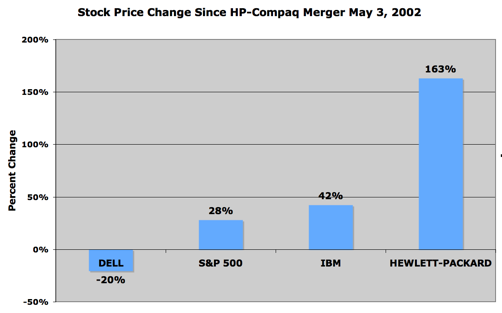
Where did the pundits go wrong? Well, first of all, they’re pundits. “Those who can, do; those who can’t, opine.” Second, they typically apply conventional wisdom (e.g., all big mergers are bad) rather than analytically looking at whether there is a real fit between the two merging companies. And finally, for the initial three years that the merged company was managed by Fiorina and was struggling, the criticism focused on the "folly" of the merger. It’s now clear to all, even to pundits, that the merger wasn't the problem; it was the management. All Hewlett-Packard needed was strong management in order to realize the latent potential of the merged company.
What are the lessons of this story? Well, we might start with this: Generalizations (and conventional wisdom) are not always true (generally speaking). And then this: Technology pundits are about as prescient as political pundits (and we know how good they are).
Another lesson: Dell Computer at the time was lauded by analysts and the business press as having the best computer industry model, the model for alltime. Now, in hindsight, it seems that the Dell model was the model for a time, not all time -- and that time has long passed.
By the way, we haven’t heard much from Walter Hewlett recently. On the day of the 2001 Hewlett-Packard board meeting that discussed the HP-Compaq merger, Walter was AWOL. Where was he? He was at some musical event playing his cello. My guess is that he is still playing his cello. You might say, then, that “Walter fiddles while HP earns.”
(But will he take a bow?)
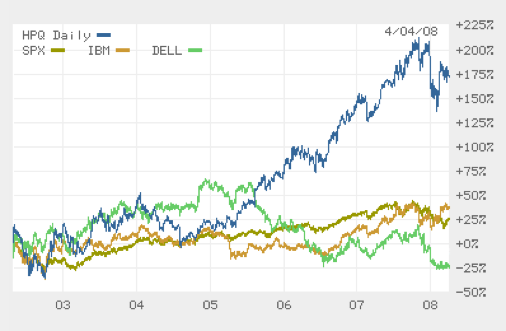
Stock Prices Since HP-Compaq Merger May 3, 2002
(Hewlett-Packard, IBM, Dell, S&P500)
Let's see. You're 82 years old, you're the father of the geostationary communications satellite, and you've won medals and honors and prizes all over the world presented by presidents and kings and other ne'er-do-wells. What to do now? Retire? Take up golf? Smell the roses?
The answer, if you're Harold Rosen, is none of the above. You look for a new challenge, one that you can solve in a unique way -- more cleverly and at a lower cost than anyone else. Since his so-called retirement some years ago from Hughes Aircraft Company's Space Systems Division (now part of Boeing), Harold barely left his office. He simply changed his title from vice president to consultant, and continues to work on novel satellite systems while waiting for big new challenges to emerge. [Full disclosure -- Harold is my brother.]
Six months ago, it happened. A really big challenge materialized -- the Google Lunar X Prize. This international competition is designed to land a robot on the surface of the moon, travel 500 meters over the lunar surface, and send images and data back to Earth. The first team to land on the moon and complete the mission objectives will be awarded $20 million.
As soon as the prize was announced, Harold began putting a team together and devising an elegant solution to the mission. TheSouthern California Selene Group (SCSG) has attracted an all-star team of space scientists and engineers, one of whom is Deborah Castleman, a former deputy assistant secretary of defense for communications command and control, and also, by the way, the wife of Harold Rosen.
One of the main objectives of the Lunar X competition is to do privately and inexpensively what the government has been doing for decades for many hundreds of millions of dollars (and tens of billions for manned missions).
The competition has attracted a large number of applicants from around the world. Ten of them were accepted in February by the prize committee, including Harold's SCSG.
So how do you win this Mission Impossible, competing against a worldwide team of talented engineers, and do it at a low cost? The answer lies in history. To get an appreciation of why the Rosen team has a good chance, and maybe even an unfair advantage, we have to go back 50 years to the beginning of the space age.
After Sputnik was launched by the Soviet Union October 4, 1957, many people in the U.S. started thinking about not only how to compete with the Soviets, but what could be done productively in space. About a year later, and inspired by Arthur C. Clarke, Harold came up with the idea of creating a geostationary communications satellite. Clarke was, among other things, a science fiction writer, perhaps best known for writing the screenplay for Stanley Kubrick's movie, "2001."
But Clarke was also a visionary. In a May 1945 article in Wireless World, Clarke proposed a system of the three satellites orbiting at 22,300 miles above the Earth, an altitude that would put their period of revolution around the Earth at 24 hours -- the same period, of course, as the Earth's rotation. As a result, these geosynchronous satellites, if orbiting around the equator, would appear stationary to an observer on earth. This all-important feature would then permit antennas on earth to be fixed and inexpensive, rather than tracking and expensive.
Vision is one thing, but execution is another. Clarke had the vision; Harold set out to realize the vision. There were significant challenges to implementing a geosynchronous satellite. It would have to reach an altitude almost a hundred times higher than Sputnik. And its orbit would have to be, and to stay, precise. So a system had to be developed to keep the satellites from drifting out of their orbit; drift is caused by the earth's non-spherical shape, by solar pressure, and other perturbations. And all important, the signals from the antennas on the satellite had to point continuously to the fixed antennas on earth.
At the time, the conventional way of controlling a satellite's position and orientation was to use a three-axis stabilization system. But the problem with that approach is that it was complex, bulky and expensive for the technology of the 1960s. To solve the problem in an economical and practicable way, Harold conjured up a novel solution, one inspired by the way a quarterback throws a football.
Ever since he was an undergraduate student, Harold was intrigued with the physics of a football pass, and the spin that the quarterback put on the ball. Only when thrown with a spiral was the ball stable in flight. This led to his thinking that if we spin a satellite in orbit, it too would remain stable in its orientation in space. Indeed, this became the hallmark of the first synchronous satellite design. The spinning motion provided the stability needed, while clever spacecraft antenna design kept the signal pointed to the antennas on Earth. When implemented, three geostationary satellites 120 degrees apart could link the entire Earth.
AT&T, by contrast, was championing a more conventional approach -- hundreds of low-altitude satellites that communicated with tracking antennas on Earth. The cost? Astronomical. Each satellite would only be visible 20 minutes, requiring complex handoffs from one satellite and antenna to the next pair. Of course, low cost was not a motivation of AT&T in those days of rate-base regulation, where the higher your rate base, the higher your dollar return.
In 1962 successfully launched Hughes Syncom II to compete with AT&T's TelStar . Which would win the battle for communications supremacy -- the geosynchronous or the random orbit? As we now all know, the geosynchronous approach won. The newly created Communications Satellite Corp. selected a Hughes satellite, a follow-on to Syncom II dubbed Early Bird, to usher in the new world of satellite communications in 1963. David had beaten Goliath.
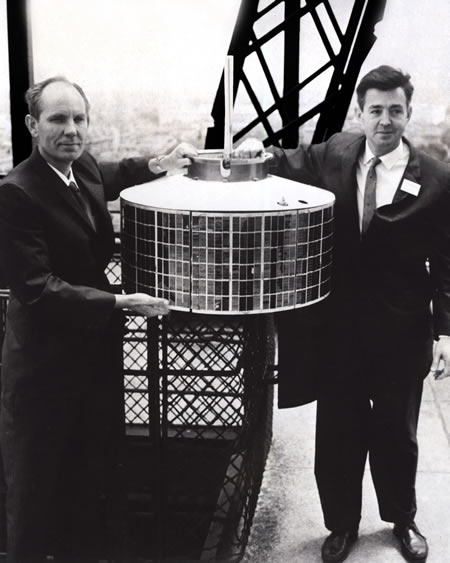
Thirty-five-year-old Harold Rosen (right) at an Eiffel Tower presentation in 1961 with a Syncom mock-up. One skeptical attendee said, "Dr. Rosen, this is as high as your satellite will ever go."
Now fast-forward 45 years to the Google Lunar X Prize. The mission is quite different from communication satellites, but the winning solution may have a striking similarity to Syncom.
Two of the most difficult problems to solve in this new competition are how to land the payload on the Moon (without crashing) and how to get it to roam on the Moon's surface. In the SCSG approach, the payload that lands on the Moon will be spinning, much as the quarterback spins his spiral pass. On separation from the launch vehicle, the payload spins itself up from the 6 rpm of the launch vehicle's spin to 50 rpm on landing. This spin gives it the stability to land reliably, simply and inexpensively without crashing.
Spinning has other benefits. It simplifies the attitude and orbit control systems, and it creates a more benign thermal environment for the delicate electronics inside the spacecraft.
Once we're on the Moon, how do we roam? The Moon's surface has very few paved roads. Indeed, it is replete with rocks, boulders, crevices, and other unwanted impediments to unfettered locomotion. The conventional approach, both historically and prospectively, has been to use a wheeled vehicle. This, however, can be complex and costly.
The Harold Rosen approach is as imaginative as it is different. The spinning payload, after landing on its spring-like legs on the Moon's surface, continues spinning (the body spins, the legs don't). When it's time to roam, instead of rolling on wheels, it hops; a small propellant thrusts it up off the surface; the spinning keeps it stable. Hopping has a big advantage. When approaching obstacles, it can, in the words of a legendary cartoon hero, leap over them in a single bound. SuperHopper!
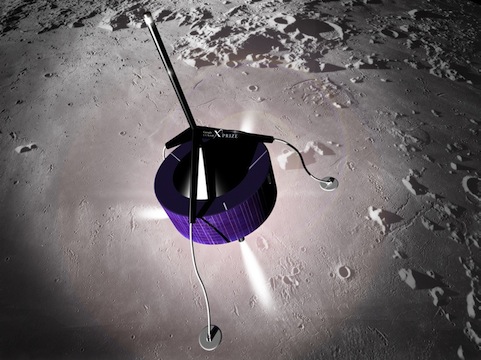
Depiction of the Southern California Selene Group's payload landing on the moon. The body is spinning, the springy legs are not.
Last summer, when Harold and Deborah were visiting us in the country, he demonstrated the stability and hopping capability of his proposed system. To do it, he used one of the world's simplest and least expensive models: a skate wheel and two hairpins. I made a brief video of his demonstration, seen below:
Video showing advantages of spin stabilization
There is, by the way, one more non-trivial challenge. To develop the system and to pay for launch-vehicles services, a fair amount of money will have to be raised. Presumably, it will come from sponsors whose interests are not commercial but idealistic. The technical challenges may prove easier to solve.
Winning the Google Lunar X prize is not Harold's only improbable goal in life. He is in training to set the world record for the 100-meter dash -- for 100-year-olds. With 18 years to go, he feels he can easily beat the record set in 2004 by a South African centenarian, Philip "Flying Phil" Rabinowitz, who ran the 100 meters in a world record 30.86 seconds (a Jewish sprinter?).
Among his training techniques are Tarzan-like swinging from overhead rings at Muscle Beach in Santa Monica, and practicing a challenging form of yoga. Here's a shot of Harold performing with the yoga peacock. I photographed him doing the peacock last year when he was still a spry 81-year-old.
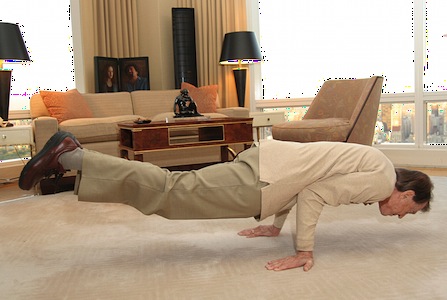
Harold Rosen performing a yoga peacock last year.
A final note. As brothers, we seem to be attracted to spinning objects. With Harold, it's spinning footballs, satellites, and lunar landers. With me, it's trays. While a member of the Fleming House Waiters Union as a Caltech undergrad in the early 50s, I became proficient at spinning trays on my finger. I'd like to think that Harold got his inspiration for spin-stabilized satellites from his brother rather than from a football, but he'll never admit to it.
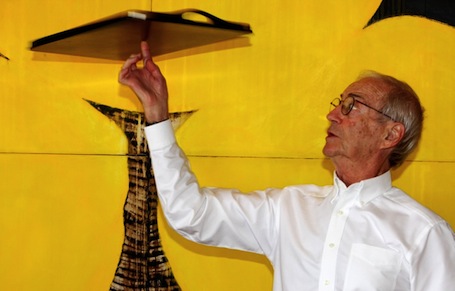
Ben Rosen spinning a tray -- his version of the origin of spin-stabilized satellites and lunar landers.
North Korea is a country with whom we’ve technically been at war since 1950. It’s a country that lost close to a million people to famine in the late 1990s. A country that prohibits its populace from contact with the outside world. International TV, travel, cell phones and the Internet are denied them. It’s critically short of food, energy, and most of the trappings of modern life. It has a nascent, and potentially threating, nuclear arms capability. Perhaps 150,000 of its citizens are political prisoners. "Why North Korea Will Not Change" is the subtitle of an article in the current issue of Foreign AffairsAnd, oh, by the way, as a reminder of the government’s absolute and repressive control, last week (just days after we left the country) it publicly executed 15 people, including 13 women, who tried to escape to China.
Yes, this is the same country that the Philharmonic group visited in late February, a trip that was marked by an unprecedented burst of worldwide television and press exposure. It’s the same country that received us so graciously, applauded our performances and reciprocated with charming musical and dance performances of their own.
Those of us who participated in this visit hope that the North Korean invitation, and our acceptance, represent a start to a process of normalizing relations. And as I discovered while there, there may be another more tangible step toward normalization that is just beginning.
Toward the end of the 48-hour Philharmonic trip, I learned about a new university being built in North Korea -- the Pyongyang University of Science and Technology (PUST). Under construction for seven years, it is scheduled to open in September.
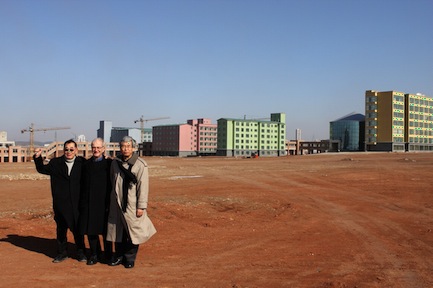
PUST President Chin Kyung Kim, Ben Rosen, Vice President David Kim
Now, there are a number of universities in North Korea already, so what makes this one special? In the words of Elizabeth Barrett Browning, let me count the ways.
The first private university: Until now, all education has been state-sponsored. By contrast, PUST has raised about $35 million, all from outside the country. Most of the money comes from Korean Christian groups – churches, foundations and individuals -- in South Korea and Korean expat communities, including the United States.
English language: Courses will be taught in English. Textbooks will be in English. Another pair of firsts.
Internet availability: Normally proscribed throughout North Korea (except for an occasional visiting Philharmonic group and the like), Internet access will be available campus-wide. This in itself is almost a revolutionary event.
International faculty: Realizing that the requisite talent for science and technology pedagogy and lies outside North Korea, most of the professors will be recruited from South Korea and elsewhere. The majority are likely to be of Korean descent.
The guiding force behind PUST is Chin Kyung Kim, or James, as he’s familiarly known. Originally South Korean, he also carries a U.S. passport and has lived and worked in Silicon Valley and Florida. About 15 years ago he started the Yanbian University of Science and Technology in northeastern China, near the Korean border. PUST is being modeled on Yanbian, which has turned out to be quite a success and has caught the attention of the North Korean government. A large part of Yanbian’s students are North Korean. The Yanbian formula – English language and multinational faculty – is at the core of PUST.
The mission of the new university is certainly grand. In James’s words:
“Above all, this will be the meeting place where two opposing ideologies can come together and learn from each other and form a middle ground which can prove a passage to unification. It will also be a place where the North Korean leaders can be exposed naturally to the world market economy thereby attaining an easy understanding.”
James himself is, to say the least, a colorful character. He is a Ph.D economist who is deeply religious, entrepreneurial, and outspoken to a fault. This last characteristic has caused him no end of grief, and almost cost him his life.
About ten years ago, because of some criticism of his of North Korean government policy, he was imprisoned as a spy and sentenced to death. Told to prepare his last will, he eloquently wrote of his willingness to die for the Korean people. It so moved Kim Jong Il that he freed James. What’s more, James then got permission from the Dear Leader to create his dream university in Pyongyang. And a government grant of 250 acres for the campus. And the use of 800 soldiers to do the construction. And the permission for English-language instruction, Internet use and an international faculty.

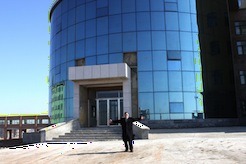
President Chin Kyung Kim at the university construction site
I met and talked with several other people involved in PUST. David Kim, a vice president of the university, is another South Korean with an American passport and a Ph.D. in mechanical engineering from the University of California Berkeley.
Iara Lee, a film-maker of Korean descent who was raised in Brazil and lives in Iran, is on the board of PUST. She and her American husband are patrons of the Philharmonic and were on the tour with me. Iara is the one who introduced me to James and David at breakfast in Pyongyang.
Subsequently, on our return, I spoke by telephone with a co-chairman of PUST’s founding committee, Malcolm Gillis. Dr. Gillis is a past president of Rice University, a former adviser to the South Korean government, and is a staunch supporter of Pyongyang University’s mission.
After a May 2008 opening ceremony, the first students will matriculate this fall. Initially, PUST will have about 150 graduate students in information technology and communications (ironic, no?), agriculture (equally ironic) and industrial management (a hat-trick in irony). Here’s a country that has little communication with the outside world, a shambles of an agricultural sector, and little industry to manage – starting a graduate school to teach all three disciplines.
In a few years, they hope to reach 600 grad students and 2,000 undergrads. The initial faculty of 40 is planned to expand in four years to 250.
To date, 18 buildings have been built, and the campus is taking shape. There is still a severe shortage of equipment, particularly computers and communications gear. And more money has to be raised. But seeing how much James and his associates have achieved so far in such difficult circumstances, and judging also by the success of Yanbian University, it’s hard to believe that his dream won’t be realized.
Pyongyang University of Science and Technology is unlike anything else I’m aware in postwar North Korea. It’s being built in self-interest, but has the chance to be a bridge to the community of nations. It will bestow a cadre of elite students with a window to the outside world, a window that is closed to the rest of the population. It will create a new generation of technocrats with the potential to lead a post-Kim Jong Il government.
Whether this newly enlightened group can be a spark plug for modernization and a force for normalized relations remain to be seen. But it’s an encouraging start. And we have to start somewhere.
In February it started with music. In September, it will be technology’s turn.
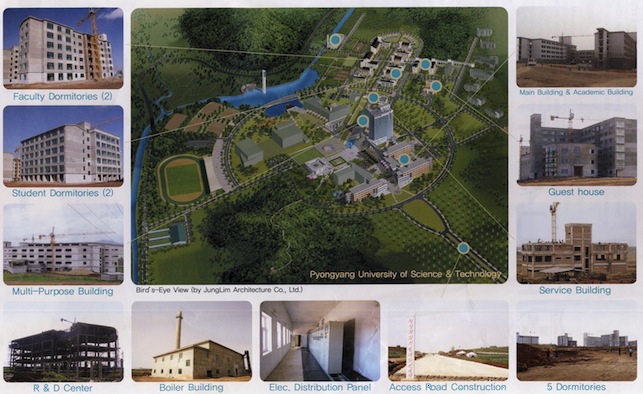
Pyongyang University of of Science and Technology campus

