Monday, January 11, 2010

Letter from London: Theatre

In November, Donna and I spent eight days in London.  For the first seven days, we attended the theater every evening. Of the seven shows, two were must-sees, one was well worth a visit, one was in tryout stage and too early to judge, and then there were three others. To wit:


The Habit of Art  Written by Alan Bennett (what more do I need to say?), this new play at the National Theatre exemplifies that rare combination of excellent acting, writing, and directing. The story revolves around an imagined meeting between W.H. Auden (Richard Griffiths) and his former collaborator, Benjamin Britten (Alex Jennings). It may be too “British” to transfer to the United States (even though “History Boys” did, and very successfully), so I suggest that you see it on your next trip to London.

After the curtain, Donna and I were waiting outside the stage door for a car that we had arranged. She spotted one of the actors standing nearby. We introduced ourselves to him. He was Elliot Levey, who played the part of the author of the play within the play. There was a thirty-minute stretch in the play where only the Auden and Britten characters had lines; the "author" of the play within a play sat in a chair at the side of the stage, script in hand, immobile.

We asked him, “What do you do to alleviate the boredom of sitting for a half hour with nothing to say or do?” He said, "You were the couple on the left side of the fourth row, weren't you?" We were blown away. He memorizes the audience! And the Olivier Theatre at the National is a big space.

So next time you’re in the theater, remember, while you’re watching the actors, they’ll be watching you. No talking, no yawning and no checking your watch.


Sweet Charity  Music by Cy Coleman, lyrics by Dorothy Fields, book by Neil Simon, choreography by Bob Fosse, the show premiered in New York in 1966 starring Gwen Verdon. The current revival in London is at the Menier Chocolate Factory on the South Bank.  

This tiny six-year-old theater has nurtured a number of shows that have moved on to the West End and Broadway, including the sublime “A Little Night Music,” now on Broadway.  If there is any justice in the theater world, “Sweet Charity” will move on to a larger theater in London and I hope to New York. A most enjoyable evening. Wonderful songs and dances on a postage-size stage.  Go see it.


Speaking in Tongues  This play is a revival by Australian playwright Andrew Bovell.  Unfortunately, it closed. But should a revival or transfer occur, see it. To whet your appetite, how's this for a structure: In the opening scene, two couples are having affairs in a sleazy hotel, not knowing their spouses are doing the same at the same time in the same hotel. Moreover, different characters speak the same dialogue in unison for long stretches (Robert Altman, anyone?) Then, in the second act, these four people play entirely different characters.  Confusing?  Well, it all comes together, eventually.

The intensity of the acting can be gleaned from this piece that appeared in the London Times a few days after we saw the show:
Gerard Earley was so impressed by Ian Hart’s performance [in “Speaking in Tongues”] that he got to his feet to applaud. Ian Hart was so unimpressed by Mr Earley that he ran from the stage to scream threats at him.
Ignoring the appeals of John Simm, his co-star, the actor lunged at Mr Earley, whom he accused of talking during his performance.
When Mr Earley protested that he had not been talking Hart launched into a furious rant and had to be restrained by ushers. Hart, who says that he does not enjoy the relationship between performer and audience, could now face police action.

Remember what I wrote earlier: the actors are watching you. So no talking. En garde.


The Power of Yes Prolific playwright David Hare was commissioned by the National Theatre to create a play that would aid our understanding of the financial crisis. What I don't understand is how such a talented playwright can produce such a boring evening of theater. My recommendation?  No to “The Power of Yes.”

Marilyn and Ella We saw what is essentially a workshop production of a play with songs. Anything involving Marilyn Monroe and Ella Fitzgerald can't be uninteresting, and this wasn't. Written by Chicago playwright Bonnie Grier, now a UK resident, the show celebrates the poignant friendship between the two icons.


La Cage aux Folles  From the Menier Chocolate Factory, this production moved to the West End and is headed for Broadway, where Kelsey Grammer will star.  Not our favorite musical.

The Priory The Royal Court Theatre is another incubator of shows that are often dramatically worthwhile and end up as commercial successes as well. It disappoints with this lightweight comedy.  But in fairness, maybe the second act that we didn’t stay for was better than the first act that we saw.


War Horse  When we saw this production on an earlier trip to London, we were astonished by the remarkable puppetry of the full-size horses that were the core of this play. The setting is the time of World War I, when millions of horses were killed in battle. The plot is modest -- boy meets horse, boy loses horse, boy regains horse.  But don't let that stop you.  The horses' performances are visually stunning, and even evoke strong emotional reactions. The play originated at the National, is now on the West End, and will transfer to Broadway.

Some Coming Attractions

We’re planning a return trip to London within the next few months to see some of the new shows. Our starter list:


Jerusalem  A comedy starring Mark Rylance, a transfer from the Royal Court Theatre to the West End.  Opening soon, it’s gathering lots of buzz.  But anything that Mark Rylance appears in goes on our must-see list, even if it's only to watch him read the telephone book. 

Enron  Also from the the Royal Court Theatre, “Enron” is moving to the West End and later to Broadway. From what we’ve heard, it sounds like the opposite (in terms of entertainment) of “The Power of Yes.”

Mrs Warren’s Profession  George Bernard Shaw and Felicity Kendall.  That’s enough for us.  Also, it’s at the Donmar Warehouse, a theatrical treasure. We can’t remember a production there that has disappointed us.

Red  A play about Mark Rothko.  Think "Sunday in the Park with George" without music and with Rothko playing Seurat.

The Misanthrope  Moliere and Keira Knightley.  How bad can that be?

A helpful source: The online London Theatre Guide is a treasure of information.  Also, there is a link on this site where you can sign up for their weekly email letter on London theatre.  Well worth getting, and free.   


Thursday, January 7, 2010

Maitake Medicinal Mushrooms

I remember it well. It was the fall of 1992. I was a guest at the Baltusrol Golf Club in New Jersey. During my round of golf, a member of our foursome noted my limping and my apparent pain. He asked me about it. I told him that I was suffering from osteoarthritis in both knees and was slated for bilateral total knee replacement. After which he said, "Boy, are you lucky. A friend of mine had exactly the same condition and also had an operation scheduled.  But he heard about a special Chinese herb, started taking it, and immediately felt so much better that he canceled his operation."

Well, that was enough for me. I immediately got the ordering information for the herbs, sent off my check, and ended up with an herb supply that would last me a year.

As soon as the herbs arrived, I started taking them, and like my golfing friend’s friend, I immediately felt better. In fact, the pain had disappeared – mirabile dictu.   I felt absolutely great and was about to cancel my operation.

That was when my secretary said to me, "I can’t help noticing that your speech is starting to slur. You're also beginning to take naps every afternoon. You may want to see a doctor."

So off I went to see a neurologist.  He subjected me to a complete neurological examination, and found absolutely nothing wrong. He couldn't account neurologically for my slurring or napping. I was about to leave his office when he asked me, "By the way, have you been doing or eating anything different in recent weeks." I told him that nothing in my daily regimen had changed, nothing that is, other than taking some herbs that helped get rid of my knee pain.

That was it. He immediately connected the dots. I wasn’t taking herbs; the “herbs” were narcotics. That experience led to my skepticism about the medicinal value of any herbs, botanicals, or unproved pseudo-medicines. (I did go through with the bilateral total knee replacement, and the knees have been pain-free for 17 years.)

Flash forward to 2009. Donna became a patient at Memorial Sloan-Kettering Cancer Center (MSKCC). We learned that among the many resources available to patients, Sloan-Kettering has an Integrative Medicine Service (IMS) that complements the mainstream medical care at the hospital. One particular IMS resource that interested me (given my earlier “herb” experience) was the access to professional information about over-the-counter products and unproven cancer treatments. And in our discussions with the IMS staff of possible complementary therapies, there was one that they were highly enthusiastic about -- maitake mushrooms.


But first, if one does a general Web search for herbs, botanicals, and other such compounds, the claims made online or enough to make one believe that there is nothing that can't be cured. But as it turns out, very few of them have any scientific basis for the claims, any studies, any clinical trials. There is simply no proof of efficacy.  The information is anecdotal.

It turns out, however, that there is one really outstanding Web source of information about these compounds. It is on the MSKCC website and called About Herbs, Botanicals and Other Products. Among the useful information provided for hundreds, maybe thousands, of the of these products is a clinical summary, purported uses, constituents, mechanism of action, adverse reactions, herb-drug interactions, and lab interactions. I would suggest that you don't put any of these purported cure-alls into your mouth until you've researched them on this website.

Now back to the maitake mushroom.  According to the MSKCC herbs website, “The maitake mushroom has traditionally been used in Japan and China as part of the diet and to treat cancer… In laboratory studies, maitake extract was able to stimulate various cells and factors in the immune system. Studies in animals show that it also slows the growth of certain tumors and lowers blood glucose (sugar) levels.”


The maitake mushroom is one of the few of these over-the-counter products where scientific research is underway to test its anticancer effects and its possible strengthening of the immune system. Phase I and II clinical trials are underway at MSKCC. The results so far show only that it’s safe. Whether it has therapeutic benefits will be learned later, in Phase III. But there is already a high level of enthusiasm around the hospital about the possible benefits of maitakes, particularly with respect to its strengthening of the immune system.

Besides their being safe, I've been reliably assured that if you take maitakes you won't slur or nap.  However, I can't promise the latter won't happen from reading this blog.


Wednesday, January 6, 2010

The Checklist

I made a New Year's resolution. (I am still in that New Year's resolution mode.) My resolution was to read more books this year. So I started off with “The Places in Between,” by Rory Stewart; followed by “Robert Altman,” a biography of the filmmaker by Mitchell Zuckoff; and then “The Checklist Manifesto,” by Dr. Atul Gawande.  Now, you might ask, how did I read three books in the first six days of the year? Well, I actually cheated, starting during the 2009 holiday season.

The Polymath


The author of "The Checklist Manifesto" is a rather remarkable individual.  He’s a surgeon at Brigham and Women's Hospital in Boston specializing in endocrine cancer. He’s rather prolific contributor to The New Yorker, where he’s a staff writer focusing on medicine and healthcare.  He’s a MacArthur Fellow.  He’s an associate professor at the Harvard School of Public Health.  He leads the World Health Organization’s Safe Surgery Saves Lives program.  He’s published three books.  He’s a frequent television guest. And he’s also the father of three children.  (Where did he find the time?)

Now who would ever want to read a book about checklists? Can you think of a more mundane topic to write about or read about?  A book about a piece of paper? The answer is, I wanted to, and not only did I enjoy it immensely, but I'm willing to bet that you will, too..

Just having finished the book, I was fortunate enough to attend a lecture by Dr. Gawande at Memorial Sloan-Kettering Cancer Center yesterday. And then last night, he appeared on Charlie Rose.

Why Checklists?

The checklist was created to help skilled people deal with complex situations.  It’s not about their ignorance, it’s about their ineptitude.  As he writes in the book, “In a complex environment, experts are up against too many difficulties. The first is the fallibility of human memory and attention, especially when it comes to mundane, routine matters that are easily overlooked under the strain of more pressing events. A further difficulty, just as insidious, is that people can mold themselves into skipping steps even when they remember them.”

Aviation Checklists

The concept of a checklist is probably most associated with aviation. It started being adopted by military and civilian pilots in the 1930s in order to deal with the increasing sophistication of aircraft. 

Some 45 years ago, when I learned to fly a Cessna 150, the checklist looked something like this:


Eight checklist items for takeoff, four for cruise, four for pre-landing, and five for approach. Twenty-one items to make it less likely I land in the Hudson River.  Just for fun, I went online and found Boeing’s checklist for its 777. In principle the big jet’s checklist is the same; just a few more items to check off.

BTW, for the good of society, I retired as a pilot after accumulating a license and 100 hours in the air.  It was not my calling (as the tower at Teterboro kept reminding me when I too often drifted into the Newark traffic pattern).  There was no checklist item to the effect of  “Are you drifting into the Newark pattern”?


Surgical Checklists

In aviation, checklists are mandatory, and over eight decades have been a major contributor to the incredible safety record of commercial aviation. But until recently, checklists haven't been widely adopted in surgery for a variety of reasons, the most likely one being that many surgeons have not been convinced of their value. What surgeon would feel it's necessary to be questioned by a nurse in the operating room before, during and after a procedure with such questions as: "Has the patient confirmed his/her identity, site, procedure, and consent”?  Or, "Is the site marked?" Or to “confirm all team members have introduced themselves by name and role.”

The person who kick-started the surgical checklist was Dr. Peter Pronovost, a Johns Hopkins critical care specialist.  That brainchild has led to a recently completed worldwide study by the World Health Organization. What prompted the interest in checklists by Dr. Pronovost and the WHO?

There are about 234 million inpatient operations performed annually around the world. In the United States it's about 50 million. While surgery is overwhelmingly successful in its role of healing patients, there are always risks of complications and even death. Major complications from surgery range worldwide from 3% to 17%.  That’s a lot of complications – surgical-site infection, unplanned return to operating rooms, pneumonia and death.

The role of the checklist is to make sure that the surgical team -- surgeon, nurses, anesthesiologists, and other operating room personnel -- make absolutely sure that the basic safety items are adhered to. Without the checklist, these items are almost always remembered. But the operative word here is "almost." Forgetting a single list item -- e.g., "has antibiotic prophylaxis been given within the last 60 minutes?" -- can result in infection or worse.  Just as forgetting to set the takeoff trim on an airplane can have dire results.

The WHO Experiment

In 2007, the World Health Organization designed a 19-item checklist intended to be globally applicable and to reduce the rate of major surgical complications. The worldwide test was initiated in eight hospitals. Between October 2007 and September 2008, eight hospitals in eight cities participated: Toronto, New Delhi, Amman, Auckland, London, Seattle, Manila, and Ifakara, (Tanzania). Patients in these eight hospitals represented a variety of economic circumstances and diverse populations.


About 4,000 patients were enrolled in the program. Data were compiled for three months without use of the checklist, and then for the following three months with it. The results are remarkable.

The Astonishing Results – Double-digit Improvements

The rate of complications -- surgical site infection, unplanned return to the operating room, pneumonia, death – fell from 11% to 7.0%, a decline of 36%. The drop in the death rate alone fell from 1.5% to 0.8%, or a decline of 47%. And these improvements were noticeable in hospitals ranging from those with the most crowded conditions (e.g., the Tanzanian hospital with 124 beds per O.R.) to the least stressed (e.g., the University of Washington Medical Center with 17 beds per O.R.).  From those with the most modern equipment and highly skilled staff to those with the least.

Let's apply the outcomes data from the WHO test to the 50 million inpatient surgeries performed in the United States annually. Without use of surgical checklists, 5.5 million patients would encounter surgical complications. With universal use of surgical checklists, the number of complications would fall to 3.5 million patients.

With regard to deaths from surgical complications, the number would decrease from 750,000 per year to 400,000. Now 400,000 deaths is not something to be proud of, but saving 350,000 lives -- from following the procedures on a single sheet of paper -- is impressive.

Small Efforts, Big Payoffs

Consider, now, what we’re talking about, and what Dr. Gawande is proselytizing and writing about. Remarkable improvements in patient outcomes have been effected not from massive federal programs and not from biomedical research breakthroughs. They have resulted from methodically paying attention to the simple things, the very simple things that allow planes to fly safely and allow patients to undergo surgery with fewer complications.

The response to the article published in the January 29, 2009, issue of the New England Journal of Medicine has been encouraging. Many state medical societies have begun recommending the use of surgical checklists, and more and more hospitals are adopting it on their own.  And France has just required its adoption for all 8,000 hospitals in the country.

The book is more than numbers. Dr. Gawande is as talented an author as he is a skillful surgeon.  Those of you who read his New Yorker pieces are well aware of his ability to gracefully describe complex topics.

I Don’t Like It, But Use It on Me

Here’s one anecdote from the book: More than 250 staff numbers -- surgeons, anesthesiologist, nurses and others -- filled out an anonymous survey after three months of using the WHO checklist. In the beginning, most were skeptical. But by the end, 80% reported that the checklist was easy-to-use, did not take a long time to complete, and had improved the safety of care.

Nonetheless, some skepticism persisted. After all, while 80% were favorably disposed, there were 20% who did not find it easy to use, thought it took too long, and felt it had not improved the safety of care.

Then the staff was asked one more question. “If you're having an operation, would you want to checklist to be used?"

93% said yes.

Back From the Dead

Another:  The opening chapter describes the case of a three-year-old Austrian girl who fell into an icy fishpond. After a 30-minute search, rescuers located her and pulled her from the pond bottom to the surface they then raced her to the hospital. Her lungs were filled with water and debris.  Her body temperature on arrival was 66 degrees.  Her brain function had ceased. She was gone. But -- the hospital was prepared.

There had been previous hypothermia victims in the area served by this small Alpine hospital, and all had died in the hospital.  Either the required people weren’t there in time, or the equipment wasn’t available, or the sequence of procedures wasn’t followed.  So the hospital set about to create a checklist to make sure that in the future everyone and everything was in place, and that everyone knew what to do when. By using this homegrown checklist, the girl in the pond was in effect brought back to life.  She is now a completely normal five-year-old girl.

Oh Well, Nobody’s Perfect

My one fault with the book: In his almost unbounded enthusiasm for checklists, Dr. Gawande goes one step too far in suggesting its universality. He illustrates convincingly how effective checklists are in the aviation and construction industries. But not leaving well enough alone, he claims -- based on a single paper by an academic -- that checklists would work well in the venture capital industry as well. Now venture capital is something I know something about (as opposed to surgery). My reaction after 15 years as a VC trying to sort out good ideas from bad, talented entrepreneurs from the ordinary, and great ideas from the mundane -- the checklist won't work here.

Having just written this, all of a sudden I'm worried.  I’m beginning to sound like a skeptical prima donna: "I don't need no stinkin' checklist."


Tuesday, January 5, 2010

Still Flying


You're at a cocktail party.  You run into a friend you haven't seen for years. Like you, he is a person of a certain age. Looking for a conversation opener, you start with a harmless enough, "Are you still playing golf"?

For reasons illustrated below, you will never again ask a question like that.

As with my last blog post, this one also involves British royalty. Some years ago, when I was Chairman of Compaq Computer, we frequently entertained major customers in the UK by inviting members of the royal family to join us at corporate lunches and dinners.  Compaq would contribute to favorite charities of the Royals; they would agree to attend our events, chat with customers, and even pose for photographs.  It was a wonderfully symbiotic relationship; the charities received major donations, and we were assured of having capacity turnouts.


One event in particular stands out in my memory. It was in the late 1980s, and Prince Philip, The Duke of Edinburgh, was our guest of honor at a major-account luncheon in London. Just before cocktails, I approached the Prince’s equerry to search for possible topics of conversation with His Royal Highness. Among the suggestions was discussing the Prince’s love of piloting the BAe 146, a British-manufactured four-engine jet.  That was really appealing to me – the Prince, then in his late sixties, was still flying jets.

Armed with this nugget, I eagerly looked forward to our lunch conversation – I had a sure topic of interest.  The Prince and I were seated at the same table, separated by the wife of our UK general manager.

But from the moment we were seated, the Prince spoke exclusively with the general manager’s wife; neither I nor anyone else at the table could get a word in edgewise.  And I was the host!  So it went during the appetizer dish and through the main course. Then, just as the waiters were clearing the entrée dishes, an opportunity presented itself. There was a momentary break in the conversation, and I seized the moment. My opening line: "Your Royal Highness, I understand that you still fly airplanes."

Silence from the Prince.  Silence from the table.  All eyes turned to us.  The Prince then spoke, staring at me witheringly: "Yes, you know, I am in that still period of life.  That period when I can still lift a fork. [He demonstrated lifting a fork.] That period when I can still lift a glass. [Ditto with a glass.] That period when I can still breathe. [Ditto]  [Pause.] Yes, I still fly.” 

With that, he turned away from me and returned to his conversation with the country manager’s wife. I, on the other hand, crawled under the table.

Since that embarrassment of twenty years ago, I have never asked anyone if he still does anything. 


Monday, January 4, 2010

Rory Stewart -- Remember This Name


You heard it here first – Rory Stewart will become prime minister of Great Britain.

Who, you say? Rory Stewart? Never heard of him. 

Okay, I’m getting ahead of myself. Yes, David Cameron, the Tory leader, looks pretty certain to win the next election, probably to be called for this May. And yes, Stewart is not now in government, and in fact has never even stood for election. And he just turned 37.  So what’s with all these bold predictions?

Well, Stewart will soon be in government.  In October he was selected by the Conservative party (from over 300 applicants) to stand for the "safe" House of Commons seat in Penrith and the Border.   This constituency, in the northwest county of Cumbria and just below the Scottish border, has been represented by Tories for decades -- even during Labor landslides.  So going from candidate to M.P. appears to be a sure thing.  But what about the leap from M.P. to P.M.?  Let’s see.

Dinner at the Palace  It all began for me six weeks ago at an event in London that Donna and I attended.  Oh, by the way, the event was at Buckingham Palace (just to drop a name). The dinner for two hundred was hosted by Prince Charles for the Council of the Prince’s Charities, a group of 20 international not-for-profit organizations that the Prince of Wales founded and supports.


During cocktails in the Throne Room, I was introduced to a young man with whom I conversed for a few minutes about a wide variety of issues – international, political, educational and philanthropic. I couldn’t help notice how knowledgeable, conversant, and charming this man was. He said his name was Rory Stewart.  It was a name that meant nothing to me at the time.  Later, at the conclusion of a most elegant dinner in the Queen’s Gallery, Prince Charles introduced the speaker of the evening. To my surprise, it was this same young man I had chatted with during cocktails.

The Dinner Speaker  Mr. Stewart’s talk focused on Afghanistan, but not on the war-related issues you read about in the media. Instead he spoke of his two years living in Kabul as chief executive of the Turquoise Mountain Foundation, a not-for-profit founded by Prince Charles. He talked about the regeneration of the historic commercial center of Kabul, where Turquoise has restored over 50 buildings, created an institute to train women and men in traditional crafts, helped businesses to export, installed drainage and water supplies, established a clinic in primary school and promoted Afghan culture through international exhibitions. Stewart spoke with eloquence, humor and a sense of proud achievement at what had been accomplished in a strife-torn country.

Who is this guy? That was the question I asked after dinner of my British tablemates and others in attendance. To my surprise, a reply that I heard more than once was, “He’ll be Prime Minister someday.” I was floored. A thirty-something being touted as a future prime minister by some fairly astute observers of the political scene? I then decided to look further into this new political phenom.

Stewart was born in Hong Kong in 1973 of Scottish parents, grew up in Malaysia and Scotland, attended Eton and Bailliol College, Oxford.  While a student at Oxford, he tutored Princes William and Harry, where his talents clearly came to the attention of their father.  After graduation he served as an officer in the British Army. Later, he worked for the British diplomatic service in Indonesia, Montenegro, and elsewhere.  He subsequently became deputy governor (at the age of 29) of the two Iraqi provinces under the control of the British.   After two years of running the Turquoise Mountain Foundation, he was appointed director of the Carr Center for Human Rights Policy at Harvard’s Kennedy School of Government.

Travels with Rory  Along the way, he followed his passion for walking. Not the kind of walking that you and I might do; the kind of walking that takes one 6,000 miles across Afghanistan, Pakistan, India and Nepal. Indeed, his Afghanistan trek was the subject of a 2004 best-selling book,  “The Places in Between.”


In my quest to learn more about Stewart, I just read the book.  It was a fascinating read, not least of which for the insights it provided into his curiosity, energy, and ability to coexist with alien and often hostile societies.   Amusingly, the book ends with his return home:  a flight to London, train ride to Dunblane, Scotland, and then, for the last 12 miles, a walk home.

Stewart on Afghanistan  In the last four years, Stewart has written on the politics and hostilities in Afghanistan. In fact, he has published so many articles and op-ed pieces that I’m embarrassed to say that I had not previously known of him. I’ve since tried to make up for that.  In the meantime, if you wish to learn more, you can get up to speed in pieces in the 


Telegraph -- A New Kind of Tory
Times of London Online-- My Long March to be a Tory MP
Bill Moyers Journal -- A video interview with Lynn Sherr.  


Not to mention many more discoverable from a Web search, including a useful Wikipedia biography.

But if there’s one must piece of reading, it is his just-published essay in the January 14 issue of the New York Review of Books. It’s long – 5751 words – but well worth attacking. 

It doesn’t do justice to the article for me to try to summarize it, but here’s the 38-word essence of what he’s saying: Neither a surge nor a full pullout is the right solution for Afghanistan. Each is fatally flawed. Instead, a modest-size long-term presence by the West is the solution that will best satisfy both Afghan and Western interests. 

Here are a few excerpts:

On the story thus far: “Eight years later this seems a tragic fantasy. Frustrated by lack of progress, the US and its allies have oscillated giddily between contradictory policies. The British government that once championed more generous budgetary support for the Kabul government now portrays it as corrupt, semi-criminal, ineffective, and illegitimate. ‘Warlords’ such as Gul Agha Shirzai, who we once demonized, are now tolerated or even praised, and are almost certain to be given good positions in the new Karzai government. We armed militias in 2001, disarmed them through a demobilization program in 2003, and rearmed them again in 2006 as community defense forces. We allowed local autonomy in 2001, pushed for a strong central government in 2003, and returned to decentralization in 2006. First we tolerated opium crops; then we proposed to eradicate them through aerial spraying; now we expect to live with opium production for decades.”


On Obama’s troop increase: “Obama should not have requested more troops because doing so intensifies opposition to the war in the US and Europe and accelerates the pace of withdrawal demanded by political pressures at home. To keep domestic consent for a long engagement we need to limit troop numbers and in particular limit our casualties. The surge is a Mephistophelian bargain, in which the President has gained force but lost time.”

On the 2010 date for withdrawal: “The date of withdrawal should be recast as a time for reduction to a lighter, more sustainable, and more permanent presence. This is what the administration began to do in the days following the speech. As National Security Adviser General James Jones said, ‘That date is a ramp rather than a cliff.’ And as Hillary Clinton said in her congressional testimony on December 3, their real aim should be to ‘develop a long-term sustainable relationship with Afghanistan and Pakistan so that we do not repeat the mistakes of the past, primarily our abandonment of that region.’ ”

On maintaining a long-term presence: “A more realistic, affordable, and therefore sustainable presence would not make Afghanistan stable or predictable. It would be merely a small if necessary part of an Afghan political strategy. The US and its allies would only moderate, influence, and fund a strategy shaped and led by Afghans themselves. The aim would be to knit together different Afghan interests and allegiances sensitively enough to avoid alienating independent local groups, consistently enough to regain their trust, and robustly enough to restore the security and justice that Afghans demand and deserve from a national government.

“What would this look like in practice? Probably a mess. It might involve a tricky coalition of people we refer to, respectively, as Islamists, progressive civil society, terrorists, warlords, learned technocrats, and village chiefs. Under a notionally democratic constitutional structure, it could be a rickety experiment with systems that might, like Afghanistan's neighbors, include strong elements of religious or military rule. There is no way to predict what the Taliban might become or what authority a national government in Kabul could regain. Civil war would remain a possibility. But an intelligent, long-term, and tolerant partnership with the United States could reduce the likelihood of civil war and increase the likelihood of a political settlement. This is hardly the stuff of sound bites and political slogans. But it would be better for everyone than boom and bust, surge and flight. With the right patient leadership, a political strategy could leave Afghanistan in twenty years' time more prosperous, stable, and humane than it is today. That would be excellent for Afghans and good for the world.”

And as for Rory Stewart?  His perceptive, pragmatic and original views of handling many of the world’s hot spots.  His years of living and working and governing in Iraq and Afghanistan.  His familiarity with languages of South Asia and the Middle East (not to mention Indonesia and the Balkans).  His serving in the British Army.  His academic credentials and professorship.  His establishing and running of a successful operation in Kabul.  His authoring two books and prolific publishing of political essays. And his unflagging energy.  Altogether, not a bad résumé for one with higher – much higher – political aspirations.

So here is a possible, and not completely incredulous, Rory Stewart timeline:

Yesterday, Kabul
Today, Penrith and the Border
Tomorrow, Westminster Palace
TBD, 10 Downing Street

And remember, you heard it here first.


Wednesday, April 29, 2009

One Mistake of the First 100 Days

Here’s your assignment:  You’ve just been elected President of the United States.  Your most urgent Cabinet appointment is Treasury Secretary, the person who will lead us out of the worst financial abyss since the Depression.

Obviously, this person must have not only the leadership skills and charisma to inspire and mobilize the country’s efforts, but must understand what got us into this mess in the first place and what will get us out.  The Secretary has to have demonstrated in the last two years a record of comprehending the financial system’s (1) high risk, (2) deteriorating capital base, (3) innovation dangers, (4)soaring leverage and (5) increasing instability.

Unfortunately, you failed the assignment.  You selected a person who, judging by his own words, comprehended none of these.  But before getting to his words, consider the crescendo of disparaging commentaries from others.  Timothy Geithner hasn’t had a lot of good press since taking over as Treasury Secretary.  Now, if possible, it’s getting worse.

In my last blog post, I lamented the appointments of both the Treasury Secretary and the head of the National Economic Council, Larry Summers. Portfolio magazine just chimed in with a less-than-flattering cover story on Geithner.  And now, the New York Times weighs in with a 5,330-word front-page piece that can only be described as a public servant’s worst nightmare -- but a must read. It takes him to task for his past actions (erratic), associations (Wall Street) and record (unimpressive).

For me, the most valuable part of the article was pointing me to the speeches that Geithner delivered during 2007 when he was president of the Federal Reserve Bank of New York, by far the most important and influential of the 12 Federal Reserve regional banks. He was delivering about a speech a month.  They varied little in their optimism.  In essence, this was the message:

Despite some serious shocks to the financial system so far, don’t worry.  The system has handled it before, and can handle it again.  You’re in good hands.

Let’s look at one of these speeches, delivered on May 15, 2007, at the Financial Markets Conference of the Federal Reserve Bank of Atlanta. Remember, the subprime mortgage mess was getting into full swing and it was just over  a year before the bankruptcy of Lehman Brothers, the forced merger of Merrill Lynch into Bank of America, and the beginning of the world economic system’s falling off a cliff. Read these remarks, and then ask yourself these questions: What in the world was Obama thinking when he nominated Geithner to be Treasury Secretary, and what was the Senate thinking when it ratified him?

“…There has been a marked improvement in global economic performance, with strong growth, relatively low inflation, and less volatility in both growth and inflation. This seems to have reduced concern about future fundamental risk, in terms of the potential damage of future shocks and in the ability of governments and central banks to both avoid the policy errors of the past and to competently manage some daunting longer–term policy challenges…

“Changes in financial markets, including those that are the subject of your conference, have improved the efficiency of financial intermediation and improved our confidence in the ability of markets to absorb stress. In financial systems around the world, the capital positions of banks have improved and capital markets are becoming deeper and playing a larger role in financial intermediation. Financial innovation has improved the capacity to measure and manage risk. Risk is spread more broadly across countries and institutions…

“These changes in economic conditions reinforce each other. The long period of relative economic and financial stability has reinforced expectations of future stability, reducing implied volatility and risk premia, increasing comfort with higher leverage, and encouraging flows of capital into riskier assets…

“The dramatic changes we’ve seen in the structure of financial markets over the past decade and more seem likely to have reduced this vulnerability. The larger global financial institutions are generally stronger in terms of capital relative to risk…”

Timothy Geithner, May 15, 2007
[emphasis added]


How could one person in such a responsible position be so wrong?   He was wrong not on a few things, not on a lot of things, but on everything.  He had no clue as to the banking system’s increasing risks, vanishing capital, innovation consequences, dangerously high leverage, and impending collapse.

Given his record for perspicacity, how can we now put credence into anything Geithner says? Is there any reason to believe he understands the   unintended consequences of  subsidizing and supporting too-big-to-fail banks, insurance companies  and automobile manufacturers; of throwing trillions dollars of taxpayer money at the economic problem;  and of buying banks’ toxic assets with highly leveraged public-private purchases.

The answer is we can’t put any credence into them. But fortunately for us, throwing trillions of taxpayer dollars pell-mell at the problems will help solve them; maybe not efficiently, maybe not fairly, and maybe not rapidly; but eventually.

Meanwhile, most of the other Cabinet appointments, in my opinion, range from pretty good to superb (e.g., Steve Chu at Energy).  And almost all the bold new initiatives in infrastructure, science, energy, health, defense, international relations, et al., are laudatory and long overdue.  Kudos, indeed.

But in dealing with the economy, by far our most critical problem, why, oh why, couldn’t we have done better?


Wednesday, April 1, 2009

It's Time for a Change

On December 8, I wrote that the praise for “Obama’s initial slate of financial appointments has been almost unanimously effusive. But not from me.” I lamented “that a great opportunity was missed – the appointment of Joseph Stiglitz to either Treasury Secretary (instead of Timothy Geithner) or head of the National Economic Council (instead of Larry Summers).”

Almost four months and hundreds of billions of misdirected dollars later, I feel even stronger about what might have been. But see what you think. Consider what has been done by our crack economic team since January 20 in attempting to solve our financial mess. Then look at the results so far (by whatever metric you wish to choose). Finally, read Stiglitz’s
 op-ed piece in today’s New York Times, “Obama’s Ersatz Capitalism.”

He describes the administration’s proposal to deal with the ailing banks as one that replicates “the flawed system that the private sector used to bring the world crashing down…overleveraging in the public sector, excessive complexity, poor incentives and a lack of transparency…

“What the Obama administration is doing is far worse than nationalization: it is ersatz capitalism, the privatizing of gains and the socialization of losses. It is a ‘partnership’ in which one partner robs the other. And such partnerships – with the private sector in control – have perverse incentives,
 worse even than the ones that got us into this mess.” [Emphasis added]

The appeal of such a proposal? He describes it as a “kind of
 Rube Goldberg device that Wall Street loves – clever, complex and nontransparent, allowing huge transfers of wealth to the financial markets.”

As to the alternative of temporary nationalization, Stiglitz suggests that “that option would be preferable to the Geithner plan. After all, the FDIC has taken control of failing banks before, and done it well. It has even nationalized large institutions like Continental Illinois (taken over in 1984, back in private hands a few years later), and Washington Mutual (seized last September, and immediately resold).”

As I mentioned in my December piece, Stiglitz was shut out of the administration’s economic team because of longtime bad blood between him and Summers (the same issue that has kept Paul Krugman on the sidelines). But it’s not too late for the administration to admit mistakes of commission and omission. Should they make a change in our economic leadership? Yes. Will they make a change? Alas, no. In Washington, politics trumps rationality.


Wall Street and the Automobile Industry

The U.S. automotive industry is now being “overseen” by Steve Rattner, head of an leveraged-buyout firm (pardon me, private equity). Chrysler was purchased two years ago by an LBO firm (oops, there I go again) started by a former Drexel bond trader. General Motors was run for almost two decades by a former finance guy, a long tradition at GM. (At least Ford’s CEO had built something tangible before – airplanes.) However the industry emerges from its current dysfunction, is there any reason to believe that there’s anyone in charge today who knows the first thing about running a successful auto manufacturer; someone who can design and build cars that people
 want without rebate incentives; someone who can recapture the two generations of youth that have eschewed the American automobile?

There are those students of management who believe that any good manager can manage a company in any industry. Call me crazy, but I always thought that one should know
 something about the business one runs. (Come to think of it, real-estate moguls running newspaper companies haven’t been too successful, either.)

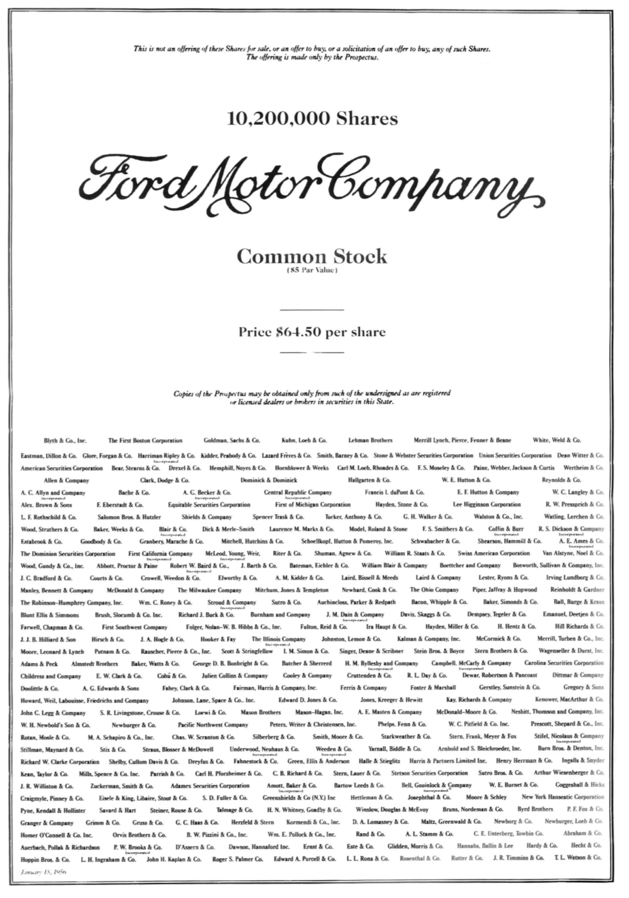
Speaking of the auto industry and of Wall Street, the then family-owned Ford Motor went public on January 17, 1956, in one of the largest IPOs ever (to that date). It was not only large in dollars, $658 million, but in the size of the underwriting syndicate. Over three hundred broker-dealers participated in the offering. (Apologies for the poor quality of the tombstone; your eyes are OK.)

Ford

Well, we know what’s happened to Ford and to the auto industry since then, and it’s not pretty. But what about all those securities firms that helped make Ford a public company? That’s not pretty a pretty sight, either.

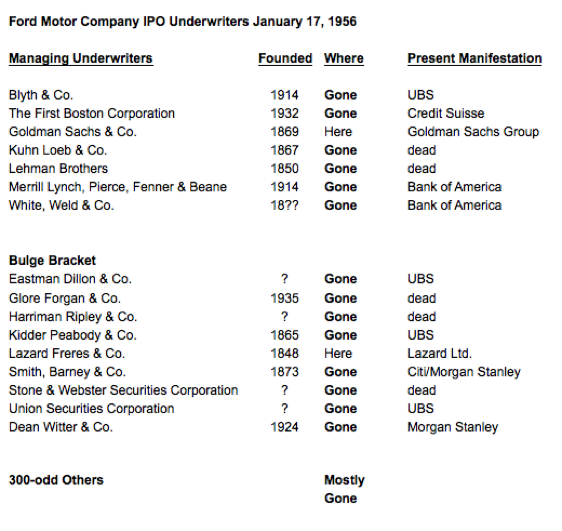
There were seven managers of the offering: Blyth, First Boston, Goldman Sachs, Kuhn Loeb, Lehman, Merrill Lynch, and White Weld. Today, only Goldman Sachs remains; the others all died or were acquired. Of the eight firms in the next largest allocation bracket, only the name Lazard remains today as an independent entity (they’ve jettisoned the Frères from their earlier name.)

Ford UW analysis

As to the other 300 or so national and regional firms, most have long ascended into that Great Stockmarket in the Sky. It’s sure a different business today from when I was plying the Street in the 60s and 70s as a technology analyst. Very few IPOs, fewer still underwriters, and even fewer technology analysts.

My Favorite Bank Advertisement of the Month

Bank of America ran a full-page in newspapers around the country with this opening line:

“We’re taking the trust and faith that America has put in us and getting to work…”

The “trust and faith” that we put into you? As John McEnroe might say, “Are you kidding me?”

This rather presumptuous claim almost rivals the one in Bernie Madoff’s pre-incarceration letter to fellow apartment owners at 133 E. 64th St. apologizing for the media frenzy in front of the building

Dear neighbors,

Please accept my profound apologies for the terrible inconvenience that I have caused over the past few weeks. Ruth and I appreciate the support we have received.

Best Regards,

Bernard

“Support we have received?” "Trust and faith put into us?"

Bizarre, or what?


Where Maureen Gets Her Material

With this economy, as William Goldman famously said of Hollywood, “Nobody knows anything.” [Emphasis added.]
Maureen Dowd, New York Times, February 21, 2009


In 1983, screenwriter William Goldman (Butch Cassidy, Marathon Man, All the President’s Men, Princess Bride, et al.) wrote Adventures in the Screen Trade, a brilliant and entertaining analysis of the movie industry. His unforgettable takeaway line that summarized the entire 436-page book, the phrase that captured the essence of Hollywood, and now the single best explanation of why we’re in such an economic mess: “Nobody knows anything.”
Through Rosen-colored Glasses, September 24, 2008 

By the way, Maureen, just to pick a grammatical nit, Bill Goldman didn’t famouslysay “nobody knows anything.” He happened to coin a phrase that became famous.

And another BTW: There is somebody who does know something: Joe Stiglitz. He just happens not to be where we need him.

Tuesday, March 10, 2009

Healthcare, Academia, Perps

HEALTHCARE – A REALISTIC OPPORTUNITY

Much of the discussion – and trepidation – about reforming our healthcare system has been based on the idea that to reform it, the system has to be blown up and rebuilt from scratch with an entirely new model. Advocates of a universal healthcare system actually look forward to scrapping what we have and creating a new “perfect” system. Detractors argue that we would thereby destroy a top-notch, if flawed system, and would in effect be throwing out the baby with the bathwater.

As it turns out, it appears possible to fabricate an all-inclusive healthcare system
without starting at zero, without attempting the politically impossible task of building a brand new model. (See Clinton, Hillary, circa 1993.) In a perceptive essay by Atul Gawande in the Jan. 26 New Yorker, the writer makes the case for building a new system on top of what we already have. Indeed, as he points out, this is way that Britain, France and now Massachusetts have reformed their health care systems. Each started with a different set of circumstances. But each ended up with a system that has come very close to providing health insurance and care to all their constituents.

“Every industrialized nation in the world except the United States has a national system that guarantees affordable health care for all its citizens. Nearly all have been popular and successful. But each has taken a drastically different form, and the reason has rarely been ideology. Rather, each country has built on its own history, however imperfect, unusual, and untidy.”

In Britain and France, the socialized health care systems came about directly from the roles the governments were forced to play in World War II and shortly thereafter, when the entire populations of their ravaged countries were already being cared for out of necessity by the central government.

Dr. Gawande describes in his essay how health care in Britain and France evolved from prewar private models to postwar public ones. He continues, as both a physician and a Massachusetts resident, to describe how the Mitt Romney-sponsored system has progressed:

“Massachusetts, where I live and work, recently became the first state to adopt a system of universal health coverage for its residents. It didn’t organize a government takeover of the state’s hospitals or insurance companies, or force people into a new system of state run clinics. It builds on what existed. On July 1, 2007, the state began offering an online choice of four private insurance plans for people without health coverage. The cost is zero for the poor; for the rest, it is limited to build more than about 8% of income. The vast majority of families, who had insurance through work, didn’t notice a thing when the program was launched. But those who had no coverage had to enroll in a plan or incur a tax penalty.

“The results have been remarkable. After a year, 97.4% of Massachusetts residents had coverage, and the remaining gap continues to close. Despite the requirement that individuals buy insurance and that employers either provide coverage or pay a tax, the program has remained fixed extremely popular.

“For years, about one in 10 of my patients – I specialize in cancer surgery – had no insurance. Even though I waived my fee, they struggled to pay for their tests, medications, and hospital stay.

“For the past year, I haven’t had a single Massachusetts patient who has had to ask how much the necessary tests will cost; not one who has told me he needed to put off his cancer operation until he found a job that provided insurance coverage. And that’s a remarkable change: a glimpse of American health care without the routine cruelty.

“It will be no Utopia. People will still face co-payments and premiums. There may still be agonizing disputes over coverage for nonstandard treatments. Whatever the system’s contours, we will still find it exasperating, even disappointing. We’re not going to get perfection. But we can have transformation – which is to say, a healthcare system that works. And there are ways to get there that start from where we are.”

Read the
 entire piece. It’s an important contribution to the healthcare dialog.


TWO TOUGH CHOICES IN ACADEMIA

Tulane
: Following Katrina’s devastating blow to New Orleans in August 2005, Tulane University was able to resume operations by early 2006. But the extended period of campus interruption and the widespread physical damage created a huge financial problem. After analyzing the trade-offs, the board chose as one of its principal cost-savings initiatives to close the engineering school (only bioengineering was spared).

To me, an erstwhile engineer, this seemed overly harsh, for both the university and New Orleans. In a city that three and a half years later still has to be rebuilt, and in a city that must attract new industry to get above water (so to speak) economically, losing its largest and best engineering school was certainly not helpful. And Tulane was a top-notch engineering school. (One example from among its many illustrious graduates: My brother Harold, father of the geostationary communications satellite, who received his undergraduate degree there.)

Yet there was surprisingly little hue and cry in the community. Perhaps it’s because when you’ve been nearly destroyed by a hundred-year hurricane, the closing of one school within a university tends to get subsumed by the enormity of losing 80% of a city’s housing stock and two-thirds its population (now one-third).

Brandeis: Fast forward to Jan. 26, 2009, when the Brandeis board of trustees, facing budget deficits and an imploding endowment, voted to sell the 7,180 pieces of art in the university’s Rose Museum and close the museum. The collection was appraised in 2006 at about $350 million, an amount of huge import to the university – it’s about two-thirds the size of the now-shrunken endowment.

Well, all hell broke loose in the art community. Everyone was appalled – museum directors, curators, critics, reporters. You’d think the board was destroying the art, rather than using its sale to allow the university to continue academic programs with cutting back any of them, such as the visual arts curriculum, which will continue.

My guess is that without the art sales or other extraordinary revenue sources, Brandeis would have to do what Tulane did – cut into the core of its academic mission and close a school or two. So what’s more important for Brandeis, to have degree-granting schools and to retain its faculty, or to have a museum? The board decided on the former. On what basis can we say they were wrong?

Most of the criticism focused on the importance of the museum to the university; it was a
 necessity. I beg to differ. The museum is a nicety, a luxury, but not a necessity. Brandeis students, located in Waltham, Mass., are not without convenient – and superior -- museum resources in the neighborhood. A stone’s throw away from the campus are some pretty decent museums in the greater Boston area – Museum of Fine Arts, Institute of Contemporary Art, Fogg Art Museum, Isabella Stewart Gardner Museum, et al.

To me, the strident criticism from those who see just one side of the issue reminds me of the hunting dog vs. kennel dog comparison that Defense Secretary Charles Wilson evoked in 1957 in a different context. The hunting dog goes out in the world and does something useful, while the kennel dog just sits around, does nothing, and yelps. Well, there’s a lot of yelping in the art community, but that yelping doesn’t help solve the problem of how do one run a university and fulfill its academic mission when a force majeure has struck, the budget is hemorrhaging red ink, donors are wounded, and the endowment has collapsed.

Tulane, with no pricey works of art to sell, had few options other than to close one of its prized academic programs. Brandeis has the luxury, if you will, of another option, one it has said it will exercise it in order to keep its academic programs extant. I cannot fault them.


(Old-fashioned) STOCKS TO THE RESCUE

Shortly after Donna and I returned from Pyongyang a year ago, we learned through news reports of how the extraordinarily repressive government there punishes offenders of the state. In March 2008, a group of 15 North Korean citizens, mostly women, were publicly executed by firing squad in a town center near the Yalu River. Their crime? Attempting to leave the country, or abetting others who tried.

This draconian punishment hasn’t ended the flow of defectors from this Stalinist state, but it has undoubtedly reduced the number significantly.

I bring this up because over the past year of the world economic crisis, I’ve been searching for an appropriate punishment for the perpetrators of the crisis. Yes, there were perpetrators. The crisis didn’t happen in a vacuum; it was not a product of spontaneous combustion. People did things, and stuff happened.

Who are the perps? Everyone has his favorite list of who the bad guys are. Many of the lists overlap names. But it’s not that important that the list be precisely accurate or complete. We just need a highly publicized public punishment of
 someone. By so doing, it will have a really chilling effect on any future excesses or wrong-doing by charlatans, opportunists, legislators, business executives, legislators, regulators, et al.

OK, so how do we punish them? At first I thought, Aha! Emulate Kim Jong Il. Set up a firing squad on Wall St. Or in D.C. Or in some foreclosed real estate development. Or in Reykjavik. (It’s a crisis without borders.)

But then I changed my mind. Instead of a quick execution, there should be a form of punishment at least as long and painful as the disaster they foisted upon us. As Gilbert & Sullivan’s Mikado suggested:

My object all sublime
I shall achieve in time
To let the punishment fit the crime
The punishment fit the crime.
And make each prisoner pent
Unwillingly represent
A source of innocent merriment!
Of innocent merriment.

Then I stumbled upon a
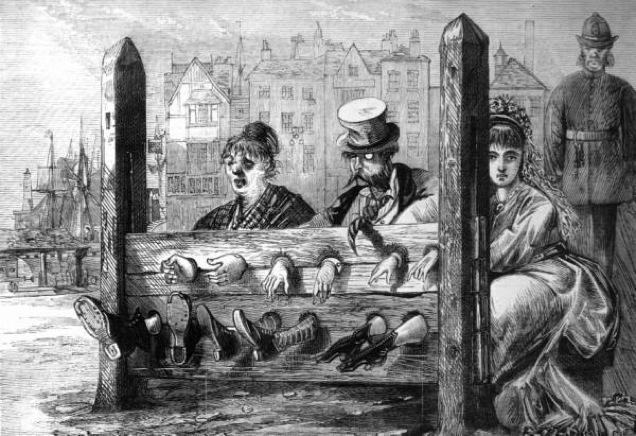
 piece by Paul Begala in the Huffington Post, and I have to admit, he had a terrific idea. Begala proposed that we bring back the stocks. No, not GM, Citi and AIG, but the wooden devices used hundreds of years ago for punishment and for public humiliation.
stock 3

Stocks

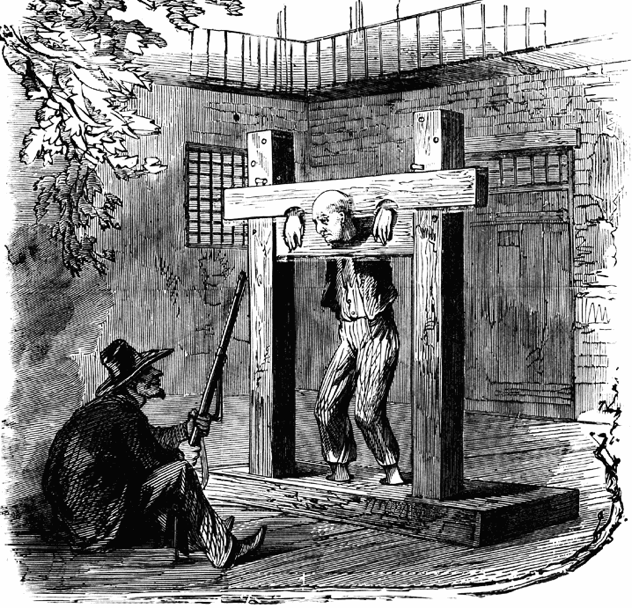
stocks 5

Ah, the shame of it all. Imagine seeing former Masters of the Universe, government officials, business executives, unscrupulous developers, and Ponzi-fund managers with their heads and hands immobilized in wooden stocks, for weeks, months, years? With an occasional ripe tomato or rotten egg thrown at them. Not as lethal as a bullet, and not as much fun for them as Club Fed, but oh boy, wouldn’t that have a great deterrent effect?

Stocks to the rescue! Just as in healthcare, prevention is a lot less costly than curing a disease.